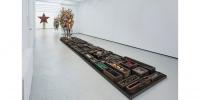
Marcel Duchamp, father of the readymade, forced the world to consider mundane things as significant objects, worthy of greater-than-average contemplation — yet his bicycle wheel, shovel, and urinal didn’t come freighted with all that much history.
On Tuesday night, Black-ish, one of the best shows on TV, returned for its fourth season. As expected, the premiere was outstanding.
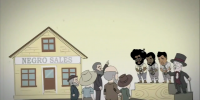
The episode was a history lesson. The subject? June 19, 1865, better known as the Juneteenth, the official end of slavery.
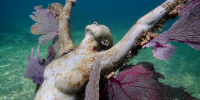
Angel Azul is an environmental documentary that follows the work of eco-sculptor Jason deCaires Taylor. Jason creates artificial coral reefs from statues he's cast from live models and installed on the ocean floor in an underwater museum off the coast of Cancún. The film explores issues that threaten the world's coral reefs which are suffering unprecedented losses.
Pine Ridge Indian Reservation is home to the Oglala Lakota, designated as part of the Great Sioux Reservation. This land and its people have endured many tragedies at the hands of the United States government. Over 500 treaties negotiated in good faith with the U.S. government have been broken, changed or nullified to suit expansionist interests. Despite centuries of oppression, the Lakota people remain resilient, faithful, and strong.
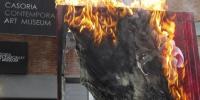
Italian museum burns artworks in protest of budget cut An Italian museum on Tuesday began burning its collection of contemporary artworks in a singular protest against harsh budget cuts that have left many cultural institutions out of pocket.
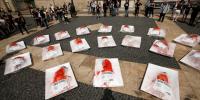
Entre el 2004 y el 2014 se registraron 982 víctimas de ataque con ácido en Colombia. En el 41 por ciento de los casos, el agresor no fue identificado. El aumento de casos llevó a que en enero pasado se promulgara una ley que endurece los castigos contra ese flagelo y con la que se busca reducir al máximo esta situación en todo el país.
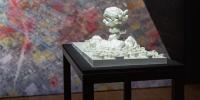
Forensic Architecture's Cloud Studies is a project that investigates the impact of toxic clouds on colonised and oppressed communities. The clouds, originating from sources like tear gas, industrial emissions, chemical weapons, and forest fires, often go unaddressed due to doubt and denialism.
Bashar al-Assad snores, his head twitching on a large white pillow. Suddenly, he wakes up. “The people want to overthrow me!” he screams, the pompom on his nightcap bouncing.
When Disney and Barneys partnered together to create a runway-ready Minnie Mouse, outrage ensued from size and body acceptance activists claiming that the new Minnie Mouse was too skinny. Ragen Chastain, a leader in the Health at Every Size movement, and founder of popular blog "Dances With Fat," jumped on the controversy, and started a change.org petition that garnered over 145,000 signatures.
The Iranian filmmaker Mohsen Makhmalbaf opens “The Gardener” with the declaration: “I am an agnostic filmmaker.” From anyone else, this might seem like a simple statement, but not from the complex Mr. Makhmalbaf. In 1974, when he was 17, religious and involved in a guerrilla group, he stabbed a policeman, for which he received a bullet to the stomach and a prison sentence.
As the Yippies prepared for protests at 1968 Democratic National Convention, Yippie Paul Krassner rattled Chicago leaders by suggesting that the Yippies were planning to put LSD in the city water supply. As Abbie Hoffman said at the Chicago Seven trial: "I read in the paper the day before that they had 2,000 troops surrounding the reservoirs in order to protect against the Yippie plot to dump LSD in the drinking water.
"Whirl-Mart Ritual Resistance is a participatory experiment. It is art and action. It came into being in 2001 as a response to Adbusters magazine’s call for foolish action on the first of April. What began as a single happening in Troy, NY has over the course of a year evolved into a ritual activity that is performed across the U.S., and known around the world.
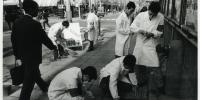
On October 16, 1964, the artist collective Hi Red Center, clad in sanitation masks and white uniforms and wielding small brooms and toothbrushes, spent several hours meticulously cleaning the streets of the Tokyo district of Ginza, amid the hustle and bustle of a “normal” day.
Camp Frack was a protest festival in Lancashire, UK, an area near industrial energy plants that produce shale gas. Around 150 activists from both Frack Off and Campaign against Climate Control (CCC) set up the festival, featuring food, music and conversation on environmentalism.
With an estimated four million surveillance cameras, Britain is by far the most-watched nation on earth. Every Londoner is on camera about 300 times a day. How could this come about in George Orwell’s mother country? What were the ignition sparks for this development? Why haven’t other nations copied the schemes if they really are as successful as the Home Office and the police are saying?
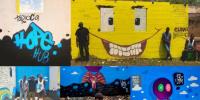
As part of the commemoration of this year’s World Art Day (April 15), Ghanaian-based Tapioca Foundation and Imposters Art Collective have embarked on a campaign to educate the public about environmental sustainability.
The project, which was launched in Ada in the Greater Accra Region, is intended to use art pieces to highlight issues relating to environmental protection and climate action to boost awareness in local communities.
Private Dinner Party: Clothing Not Allowed
The Füde Dinner Experience gathers those who want to meet, eat and drink — only after leaving their clothes at the door.