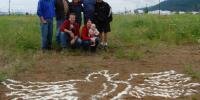
On Saturday, June 22, a group of friends will meet at one of the more than 4,000 natural gas wells that have been drilled by hydrofracking in Pennsylvania. Instead of picket signs, however, they'll be carrying a picnic basket. For an event they're calling "Picnic on the Gas," they'll strive to show that it is possible to live with creativity and even joy in gas drilling country.
The protracted queue. That was the first thing I noticed when I arrived. It was winding, unending and impossible to see exactly where it began. I asked one of the security guards if he had any indication as to the waiting time. His response was a “your guess is as good as mine” shrug. As the mammoth line snaked around the building, my heart sank further – it is a myth that Brits love to queue; we feel compelled to, we don’t love it.
Resonate, Reverberate, Roar (Re-Re-Roar) is a growing archive of original sounds that express an experimental, independent, and socially progressive spirit. The sounds on Re-Re-Roar include field recordings, interviews, songs, speeches, experimental music, and more. Re-Re-Roar is a site for research and activ[ist] listening, with the purpose of distributing sounds of resistance to eager ears around the globe.
Through their podcast, The Dance Union, Melanie Greene and J. Bouey have been confronting racism in the dance world, and highlighting the experiences of Black artists, since 2018. Their episodes cover a variety of topics and issues, ranging from mental health and sexual harassment to advocating for fair pay.
"Built from the ground up by Black trans coders and developers, The Black Trans Archive takes the form of a video game, allowing visitors to interact with its content in real-time, making their own contributions in the process. It’s also specifically designed to ensure that this work can never be deleted, allowing everything contained within it to persist long beyond anyone who was involved in its creation.
Mayday is a neighborhood resource and a citywide destination for engaging programming, a home for radical thought and debate, and a welcoming gathering place for people to work, learn, drink, dance and build together.
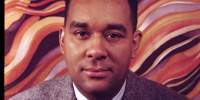
Between the World and Me
by Richard Wright
And one morning while in the woods I stumbled
suddenly upon the thing,
Stumbled upon it in a grassy clearing guarded by scaly
oaks and elms
And the sooty details of the scene rose, thrusting
themselves between the world and me....
The Critical Engineering ManifestoThe Critical Engineer considers Engineering to be the most transformative language of our time, shaping the way we move, communicate and think. It is the work of the Critical Engineer to study and exploit this language, exposing its influence.
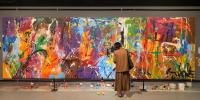
At a gallery within a shopping complex in the South Korean capital, a couple saw paint cans and brushes at their reach and use next to what was actually a finished portrait worth hundreds of thousands of dollars. Thinking the available paint and brushes was a signal to be a part of the art, they ended up technically vandalizing the artists' work.
In 2012, visual artist Shilo Shiv Suleman started Fearless in response to the powerful protests that shook the country in response to the “Nirbhaya” tragedy in Delhi, India.
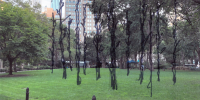
From an Art Net News Article: ""The installation is called Ghost Forest, a term used to describe vast acreages of woodland that have died out–often due to rising sea tides, which overwhelm forests near estuaries with saltwater, choking out their ability to get nutrients from the earth. In 2012, Sandy caused seawater levels to surge, leaving swaths of ghost forests in its wake.
Missourians are fighting against legislation that would essentially make it legal to bully against LGBT students in the state’s schools. From the activists' site (http://oktosaygay.org/):
If you headed into the West 4th St. Subway Station on March 9, 2014, you may have seen a group of people writing on cardboard, taping it to the walls, and seemingly holding a small class in the underground space. Those were some of the members of Free University NYC, a radical educational project started during May 2012 as a form of educational strike. They hold classes in public spaces like parks and subway stations, and are entirely free.
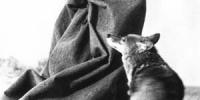
It was 1974 when Beuys arrived in New York City, ready to tackle a whole new challenge and create what was to become one of the most famous works of art of the time. Upon arrival, his assistants wrapped him in a large piece of felt and transported him, by ambulance, to the René Block Gallery in SoHo. There, awaiting the artist, was a live coyote. Beuys spent three consecutive days, eight hours at a time, locked up with the wild animal.
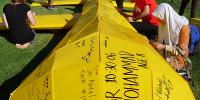
Media artist Joseph DeLappe announces the completion of “The Drone Project: A Participatory Memorial” on the campus of Fresno State University in California.
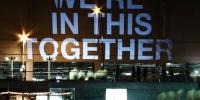
From Creative Time, Social Practice Archive: Produced by the Windsor, Canada-based collective Broken City Lab—an artist-led interdisciplinary research group—Cross-Border Communication was a performative public art project that took place in November 2009 between the cities of Windsor and Detroit, which are separated by the Detroit River. For three nights, Broken City Lab projected a series of messages across the river which were visible in Detroit.
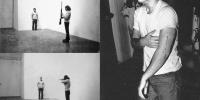
"I had an intuitive sense that being shot is as American as apple pie. We see people being shot on TV, we read about it in the newspaper. Everybody has wondered what it's like. So I did it." - Chris Burden
In light of his recent death, I wanted to bring one of Chris Burden's pieces, Shoot, to Actipedia.org. Not just to honor the artist, but to also remind us of our country's insane fascination with guns and violence.
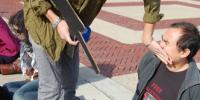
Students dressed as Israeli soldiers stopped other students, ordered them to the ground, and blindfolded them in a demonstration that drew multiple campus groups to a standoff on College Walk Thursday afternoon.
The Columbia Students for Justice in Palestine set up mock checkpoints—to resemble those manned by the Israeli army in the West Bank—drawing crowds and counter-protests for several hours.
Song Dong's Waste Not consisted of a single installation comprising over 10,000 commonplace, domestic items of daily life that had been used and amassed by the artist’s mother (Zhao Xiangyuan) over fifty years.