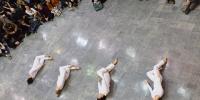
"A Night of Philosophy and Ideas is a thinker’s lollapalooza. The free, 12-hour weekend lyceum at the Brooklyn Public Library includes spirited debate, live music, theater, performance art pieces, and film screenings. At any given hour, five or six different events will be taking place simultaneously. Visitors are encouraged to come and go as the spirit moves them.
Since the beginning of Bulgaria's transition to democracy, the monument’s meaning and future has been the subject of heated debates. Opponents to the monument aren’t happy about the presence of such a dominating foreign army monument in the country that is situated higher and more central than national symbols. In recent years, the monument has turned into a canvas for anonymous political statements on multiple occasions.
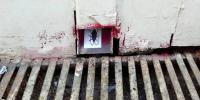
This is the image confronting Greeks from an Athenian drain . "Hello, I live in the sewers of Athens," says the cockroach. "Yes, me too," says an Athenian walking past, apparently unfazed by the idea of an insect talking to him from a drain.
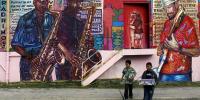
CENTRO San Antonio's Art Everywhere Project will celebrate its 5th anniversary in May.
As of May 2024, the project had seen numerous artists from the city's urbancore decorate areas of the city with elaborate murals reflecting the city's history and the diversity of cultures in the city.
Cheril Linett is a female artist from Chile, with a background in performance art and stage performance, who primarily focuses her artwork on feminist issues in Chile, especially ones involving violence, murder, hate crime and different kinds of oppression and assault, but also creates artwork reflecting issues in other parts of Latin America.
Students from Colombia College teamed up with Greenpeace and The Yes Men to take on the Chicago coal industry in an elaborate, multi-layered hoax. The group created a scheme to announce that a new coal plant was planned—but instead of going in a poor neighborhood (like the two coal plants that already exist), this one would be built in a rich one.
São Paulo went through a process of privatization of the public spaces. The local government implemented several rules that beneficiated the real state speculation, the city is expensive, and it's not for the poor.
Besides that, in october the elections were a hard game for the progressive party, PT, since two conservative candidates had big shares.
Flushing Creek is so hidden by industrial sites and highways, it’s almost invisible to those passing through the Flushing neighborhood of Queens. “I lived in Flushing my whole life and didn’t know that I lived near waterways until I was 20 years old,” Cody Ann Herrmann told Hyperallergic.
In São Paulo, just like in many other metropolitan regions, public transport is not as effective as it could be. Buses and trains usually run overcrowded, late and on limited hours, so that owning a car increases a lot one’s comfort. But not everybody can afford to have one, so a clear and recurrent class distinction occurs: public transport is mostly used by poor people.
This action was suggested in the workshop assembly by a neighbor of Arrayán street itself. At the end of this street giving the market there was a wall in a state of collapse that
concerned the neighborhood. On several occasions, either neighbors or from the same Peña Bética in front of them, they had
given by the City Council, but without results. And every day having to go all the way through that gorge with two
This week, I got to make history. At 18 years of age, I received an honorary doctorate from the University of London for my work in climate justice, making me the current youngest holder of the award globally.
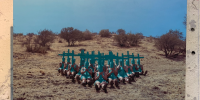
In July and August 2013, O Teatrão, a Coimbra based theatre company, presented the project Arruinados, comprising three theatre performances in three abandoned spaces (‘ruins’), one in each of three cities in the Centre region of Portugal located along the Mondego River:Coimbra, Montemoro Velho, and Figueira da Foz.
This was a protest posted on Change.org in response to NYU's forced eviction deadline on students living in on-campus housing.
The following was the information posted on the site:
We, the undergraduate student body of New York University, strongly urge NYU to rescind the call for students to evacuate NYU residence halls before March 22nd.
Cheril Linett is a female artist from Chile, with a background in performance art and stage performance, who primarily focuses her artwork on feminist issues in Chile, especially ones involving violence, murder, hate crime and different kinds of oppression and assault, but also creates artwork reflecting issues in other parts of Latin America.
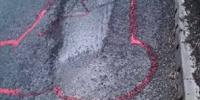
Armed with a can of washable spray paint, an artist in Greater Manchester, England, has embarked on a worthy crusade: to rid the region of potholes… by drawing penises on them.
The anonymous artist, who goes by the name “Wanksy,” told the Manchester Evening News that he decided to draw attention to the “appalling” pothole-ridden streets after some of his cyclist friends were badly injured on the roads.
The Bed-Stuy “aquarium” is back.
The neighborhood’s beloved sidewalk fish pond was resurrected this week — in an act of defiance that comes just five days after the city cemented over the original and left the neighborhood’s goldfish to die.
In early 2012, a group of artists, activists and assorted other odd balls got together to form People's Tours. The idea was to give walking tours in the Boston area. Standard enough. But instead of the usual history, we would talk about social justice, contested spaces, important protests, and shady corporations.
So far, the group has consisted of Dave Taber, Heather McCann, Kristin Parker, Neil Horsky, and Tim Devin.
Swedish lesbian, gay, bisexual and transgender (LGBT) rights advocates offered their colorful stance on Russia's controversial anti-gay legislation over the weekend.
On the afternoon of September 11th, nearly a hundred people hugged each other to feel the beauty of the hug on the Paris Square in front of the Brandenburg Gate in Berlin, under the leadership of the Chinese artist Gao Brothers. At the beginning of the event, the Germans have not yet adapted to the behavior of embracing strangers, but encouraged by Gao brothers, people have opened their arms and gave the strangers around them a warm hug.
In March this year, less than 100 days since he took office again, Luis Castañeda Lossio, Mayor of Lima, announced that the Municipality would remove the street art murals painted on the walls of downtown Lima’s historical city streets. “Lima has to recover all the architectural quality it has. They have chosen us and we will comply with the obligation that the population has consigned us,” said the mayor.
Conceived and curated by Bushwick native Joe Ficalora, the Bushwick Collective has evolved into an extraordinary open-air gallery since its first mural surfaced in 2011.
Attracting a wondrous array of local, national and international artists, it showcases first-rate street art -- from legendary Blek Le Rat stencils to huge collaborative walls by such world-renowned artists as Case Ma'Claim and Pixel Pancho.
"Improving
the livability of our towns and cities commonly starts at the street,
block, or building scale. While larger scale efforts do have their
place, incremental, smallscale improvement efforts are increasingly seen
as a way to stage more substantial investments. This approach allows a
host of local actors to test new concepts before making substantial
Using Performance Art to Alert Drivers to Look Out for Pedestrians
A series of three street performances taking place this Thursday and Friday carries a simple message - remember to see and stop for pedestrians.