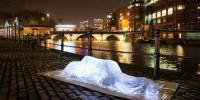
Artist Luke Jerram created a genderless sleeping figure made of glass lying on a piece of cardboard and exhibited in the streets of London. The artist said in an interview "For every person you see sleeping on the streets, there are many others sleeping in hostels, squats and other forms of unsatisfactory and insecure accommodation.
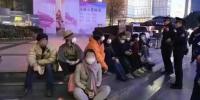
In the south-western city of Chengdu, by all accounts a city on the edge coping with heavy pollution but also with authorities scrambling to put a lid on simmering discontent. That night police detained a number of artists who managed to stage a silent demonstration, while wearing face masks.
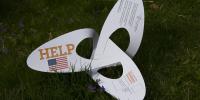
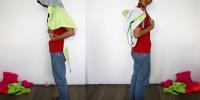
The “Wearable/Portable Architecture project” discussed the possibilities of having a locale create portable architecture based on the conditions of its environmental, urban and cultural conditions. It is structured to find ways in providing new arguments and sustaining an artistic impetus to our immediate environment.
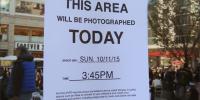
"This area will be photographed" is a public performance of implied photographic consent, inspired by Google's street view and satellite surveillance. Posted signs and handbills alerted the public present in Union Square, New York, NY that a photograph would be taken of the area at a precise time.
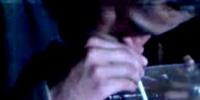
Renowned Cuban artist Tania Bruguera surprised a Bogota audience in September when she lined up three people directly involved in the Colombian conflict for a chat. The real performance however, started when a waitress emerged with a tray of neatly organised lines of cocaine, and began offering them to members of the audience.
#SaveNYC is a grassroots, crowd-sourced, DIY movement
to protect and preserve the diversity and uniqueness
of the urban fabric in New York City.
As our vibrant streetscapes and neighborhoods are turned into bland, suburban-style shopping malls, filled with chain stores and glossy luxury retail, #SaveNYC is fighting for small businesses and cultural institutions to remain in place.
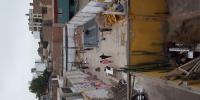
La Casa Negra is a moving artist squat that occupies houses destined for demolition as temporary venues for site specific performance art in Barranco (Lima, Peru). Artists use all of the available rooms (kitchen, bathrooms, stairs, backyard) to enact a series of critical art pieces, while using the space as a demonstration of artist resilience in an increasingly gentrifying neighborhood.
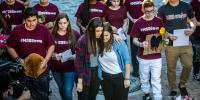
Shine, written by Stoneman Douglas students Sawyer Garrity and Andrea Peña in response to the tragic shooting at their school on February 14, 2018 to inspire unity, hope, and change. MSD alum Brittani Kagan collaborated with students and faculty to create this music video to honor the victims and the school.
On Nov. 6, the day after the presidential election, the artist Hank Willis Thomas was at his studio in Brooklyn. His production assistants were poring over tables strewed with blobby red white and blue silk-screen prints of the words “Fragile/ Democracy / Handle With Care” in capital letters.
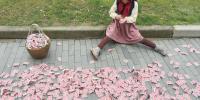
On January 12, 2016, Shanghai's temperature dropped to its lowest of the year. A little girl was seen selling matches in the cold wind on Bund street. The little girl, wearing a classic dress, wrapped in an ocher-red scarf and carrying a small bamboo basket full of matches, gave matches to passers-by.
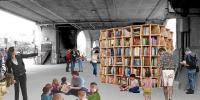
"The Uni Project aims to do one thing and do it well: temporarily
transform almost any available urban space into a public reading room
and venue for learning. We start with the conviction that books and
learning should be prominent, accessible, and part of what we expect at
street-level in our cities." (From site.)
AMNA NAWAZ: Since anti-government protests erupted in Iran last year, people around the world have taken to social media to show their support.
That includes an Iranian American ballerina who's tapping into her own heritage and her art, in solidarity with those pushing for more rights.
The "NewsHour"'s Julia Griffin reports for our arts and culture series, Canvas.
São Paulo went through a process of privatization of the public spaces. The local government implemented several rules that beneficiated the real state speculation, the city is expensive, and it's not for the poor.
Besides that, in october the elections were a hard game for the progressive party, PT, since two conservative candidates had big shares.
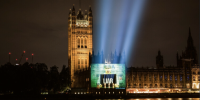
The creative fusion of art and activism in urban spaces has propelled the British collective Led by Donkeys into the spotlight, garnering millions of views for their interventions on social media. Their critical visual occupations - whether billboard messages during the day or large-scale projections at night - raise a compelling question: which medium holds the greater persuasive power?
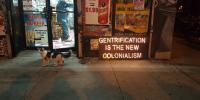
Since Christmas Eve, some lights along the streets and in the houses of Bushwick have spelled out a number of messages quite different from the festive wishes one usually finds during the holiday season. “GENTRIFICATION IS THE NEW COLONIALISM,” “NOT 4 SALE,” and “NO EVICTION ZONE,” some read.
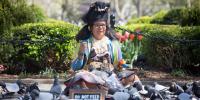
Tina Piña, better known as Mother Pigeon (@motherpigeonbrooklyn), is an artist and self-described “high priestess of the pigeon religion,” whose passion for New York City’s often-overlooked bird has helped her carve out a unique creative niche centered around pigeons—as well as a lifestyle geared towards helping New Yorkers appreciate the misunderstood creatures.
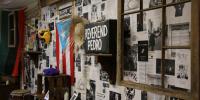
Spread over three institutions — the Bronx Museum of the Arts; El Museo del Barrio in East Harlem; and Loisaida Inc., a cultural center in the East Village — this show departs from straight political history by presenting the Young Lords as a cultural phenomenon as well as an ideological one, with a highly developed instinct for visual self-projection, right down to having an official party photographer, the gifted Hiram Maristany.
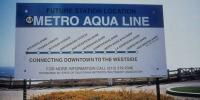
Creative Time, Social Practice Archive: In 2000 Heavy Trash, an anonymous arts organization of designers, architects, and urban planners, implemented its Aqua Line project throughout various parts of Los Angeles. The project involved the installation of false "Future Station Location" signs in the downtown area, notifying passersby of the impending construction of a subway that would connect the downtown to the Westside.
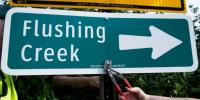
Flushing Creek is so hidden by industrial sites and highways, it’s almost invisible to those passing through the Flushing neighborhood of Queens. “I lived in Flushing my whole life and didn’t know that I lived near waterways until I was 20 years old,” Cody Ann Herrmann told Hyperallergic.
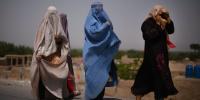
In December – as many around the globe were preparing for the holidays – Sama, a former attorney, remained hunkered down in her house in Kabul, Afghanistan, trying to comprehend how her world had changed.
Ghana ThinkTank is an international collective that “develops the first world” by flipping traditional power dynamics, asking the “third world” to intervene into the lives of the people living in the so-called “developed” world.
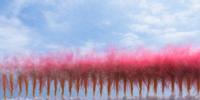
On June 26, contemporary artist Cai Guo-Qiang released the daytime firework display ‘When the Sky Blooms with Sakura’ at Yotsukura Beach in Iwaki City, as commissioned by Saint Laurent’s creative director Anthony Vaccarello.
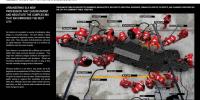
Whose job is it to create a city? Our intention is to jumpstart a new profession that can re-invent and negotiate the complex mix that encompasses a city. We have defined a radical new occupation to regenerate, pioneer, and sustain the future urban realm. These innovative multi-disciplinarian advocates are called Urbaneers. Their immense task is to manifest and facilitate the next expression of city across the globe.