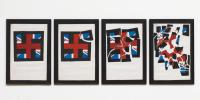
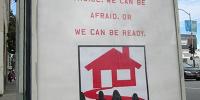
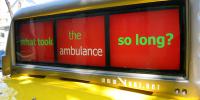
Taxi is a car with a digital advertising sign attached to the roof. Linked to a global positioning system, the message changes relative to the car's location, addressing specific neighbourhoods, addresses, and audiences. The technology can target an area as small as a square block. Haha solicits messages through email list serves and through direct contact with various groups throughout the city.
The New York City subway is many things, but clean isn’t necessarily one of them.
It doesn’t exactly smell great, either.
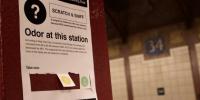
While the MTA hedges on solutions (and continues to debate whether eliminating trash cans from the stations actually solves sanitary issues), the artist and School of Visual Arts student Angela H. Kim is waging a personal guerilla war against the olfactory offensiveness of it all.
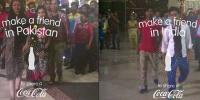
A new, three-minute ad by Coca-Cola, "Small World Machines," starts with a relatively straightforward premise: India and Pakistan do not get along so well. It ends with the promise of peace: "Togetherness, humanity, this is what we all want, more and more exchange," a woman, either Indian or Pakistani, narrates as the music swells. Sounds great. How do we get there? By buying Coke, of course.
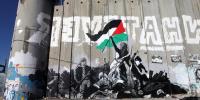
In June 2002, the Israeli Government decided to construct a physical barrier separating Israel and the West Bank. The declared purpose of this (as yet unfinished) 709 kilometers long barrier—which came to be known as Gader Ha’hafrada (The Separation Wall)—was to prevent the entry of Palestinian terrorists from the occupied territories into Israel in order to protect Israeli citizens.
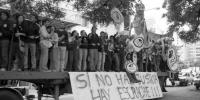
Faced with a lack of prosecution of those accused of crimes against humanity committed during Argentina’s military dictatorship, family members and descendants of the country’s estimated 30,000 disappeared took action.
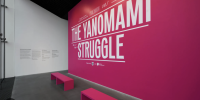
A new exhibition at The Shed in New York is a colour-soaked, eye-opening look into Yanomami life – an Indigenous culture in the heart of the Amazon rainforest
FEBRUARY 13, 2023
TEXT: Violet Conroy
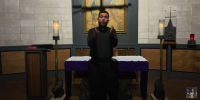
WEST MIAMI-DADE, FLA. (WSVN) - A seminarian and faculty member at a South Florida school is taking a creative approach to engaging with students about challenging issues during this time of uncertainty, including the coronavirus pandemic. He made a rap video.
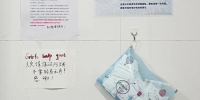
HONG KONG — It started when a single box of free sanitary pads appeared in a middle school classroom in October. Then a plastic container with pads was attached to the walls of four bathrooms in a university in Shanghai. By Monday, boxes and bags of individually wrapped pads had popped up outside bathrooms in at least 338 schools and colleges across China. Each carried a version of the same instructions: “Take one, then put one back later.
With the intention of recognizing the work of the Latin American carreteros (garbage pickers) that collect recyclable materials in wheel carts, and increase environmental consciousness, artist Mundano created “Pimp My Carroça"
In partnership with Southwark Council, Peckham Settlement, Peckham Space and Resonance FM. Supported using public funding by the National Lottery through Arts Council England and Kickstarter Campaign supporters.
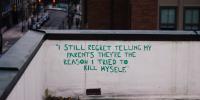
"What I Couldn't Say in Public" transforms individual secrets into a public, anonymous spectacle.
While origins and exact location of the "What I Couldn't Say in Public" project are unknown, awareness about the project has grown over the micro-blogging platform of Tumblr. Amassing over 132,480 notes on the website, this practice may have possibly inspired others to imitate the same or similar projects in different locations.
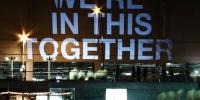
From Creative Time, Social Practice Archive: Produced by the Windsor, Canada-based collective Broken City Lab—an artist-led interdisciplinary research group—Cross-Border Communication was a performative public art project that took place in November 2009 between the cities of Windsor and Detroit, which are separated by the Detroit River. For three nights, Broken City Lab projected a series of messages across the river which were visible in Detroit.
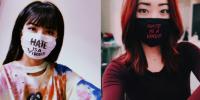
Activists fighting coronavirus-driven hate crimes are rallying on social media to turn masks into a symbol, rather than a target in racist attacks
Jeff Elder Apr 6, 2020, 2:03 PM
Activists against COVID-19-related hate crimes are leading a social media campaign using images of people in masks to fight back against attacks on Asian-Americans, which Congress and the FBI say are increasing.
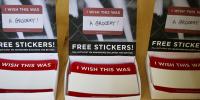
I Wish This Was is a participatory public art project that explores the process of civic engagement. Inspired by the limited dynamics of community meetings where the loudest people ruled, as well as the volume of abandoned buildings, Chang posted thousands of “I wish this was ___” stickers on vacant buildings across New Orleans to invite residents to easily share their hopes for these spaces.
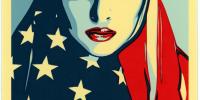
Colorful portrait of a Muslim woman wearing an American flag colored head scarf. Image on back of a woman with a rose in her hair in black and white with text that states, "We are resilient. We are indivisible. We are greater than fear. We will defend dignity. We will protect each other." -- "The We the People campaign aims to restore hope, imagination, curiosity, and creativity into our country’s dialogue.
Carlos Hernández Chávez is a Mexican-American muralist who brings the spirit of 20th-century Mexican muralism into modern New England. Chávez’s murals address key social justice themes, including immigration, workers’ rights, and cultural identity, challenging viewers to acknowledge and reflect on pressing societal issues.
Many of the banks originally situated on Bank Street in Sharjah have left for more lucrative locations, so we have imagined a new, non-monetary banking model for the street.
What if we were to regard the sum total of memories and stories of the people in this area as the real capital of the street?
And what if this new currency could be invested in the new Bank Street and converted into physical objects?
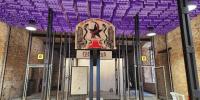
The Mexican Pavilion is an immersive space based on a 1:1 scale fragment of the expanded model of the campesino basketball court, an infrastructure that has become repurposed as a space for poly- and pluri-valent processes of decolonisation in Mexico’s indigenous communities.
"As of October 2009, Retznei boasts a new centre. In the middle of the square the black contours of a concrete surface stand out, reminiscent of the shape of a pond. If you step on the Platform, you notice that the ground gives slightly and that it sways. Invisibly but noticeably, water reveals itself as a key component of this art work by Michael Kienzer. The water carries the Platform and us, while we are walking or standing on it.