Sewing and textiles have always been a part of the artist Aram Han Sifuentes’ life. Her South Korean immigrant parents operated a dry cleaning business, and she mended her own clothing from a young age.
"Send It On" is a song recorded by American recording artists Miley Cyrus, Jonas Brothers, Demi Lovato and Selena Gomez from charity project Disney's Friends for Change. The track's producers Adam Anders and Peer Åström co-wrote it with Nikki Hassman. The song was released on August 11, 2009 by Walt Disney and Hollywood Records as a charity single in order to benefit international environmental associations.
In 2016, Zhou Zhenfeng, who was a student at a college in Hebei at the time, discovered that there were a lot of waste tires in the streets and alleys. Zhou Zhenfeng learned that tires are made of infusible or refractory polymer elastic materials. It takes hundreds of years for these materials to decompose in the soil to the extent that they do not affect the growth of plants.
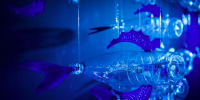
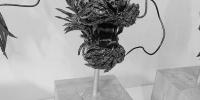
New Zealander artist George Nuku has presented his latest work as an installation that imagines the state of the world's oceans 100 years in the future where plastics have totally changed the marine environment.
Unveiling the Unseen
BlindWiki is a location-based audio network where citizens who are blind or partially sighted use smartphones to share their findings by posting sound recordings. The platform does not just contain information about difficulties and barriers but is also a repository for experiences, opinions and stories, generating a creative and collaborative cartography of the unseen.
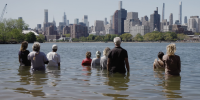
A site-specific, community-engaged process: Sarah and NYC collaborators gathered at the water’s edge every month from September 2020 (when the work was initially scheduled to take place but was postponed due to the pandemic) until September 2022, to build Kin To The Cove, a site-specific community-powered environmental public art process that connects local residents to the Cove and Water that surrounds NYC.
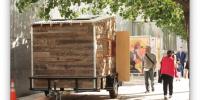
The project consists of a small mobile workspace and a micro artist residency program composed by two tiny art studios founded in Oakland. Studio 1 is a solar powered art studio which was built on the back of a flatbed trailer and Studio 2 was built in collaboration with students at Stanford University, both spaces are composed of second-hand materials.
Climate protesters in Washington, D.C. were handcuffed on Thursday after they dragged paint on a glass cover protecting an art sculpture.
The incident happened at the National Gallery of Art by the activism group Declare Emergency in an attempt to bring attention to climate change, according to the Washington Post.
The following description is taken from Amanda Froelich's article on www.trueactivist.com (link below):
"Dumpster diving is a topic that is rising in popularity. Just take a peek at Rob Greenfield! This activist won’t hesitate before jumping in a dumpster, but he’ll also take time to spout reasoning behind why we should work hard to ‘waste less’.
"To that end, in the Spring of 2014 we launched the Chasing Ice Ohio Tour in an attempt to use the film to shift the political conversation around climate change. As a society, for us to address climate change properly, we need our leaders in Washington to stop debating about whether or not it is actually happening and start taking action.
Björk and the French artist Aleph have collaborated on an immersive, AI sound piece that recreates extinct animal calls, set to run at the Pompidou Centre, in Paris, from November 20 until December 9. It will play as visitors travel on escalators in the art museum, as part of its “Biodiversity: Which culture for which future?” forum.
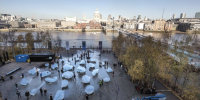
Danish-Icelandic artist Olafur Eliasson has extracted 30 blocks of glacial ice from the waters surrounding Greenland and placed them in public spaces across London, where they will be left to melt.
Called Ice Watch, the temporary installation is meant to serve as a visual reminder of the impact of climate change on the environment.
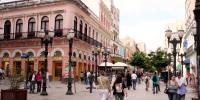
In the 1970s, Jaime Lerner, the former mayor of Curitiba, Brazil, transformed six blocks of the main downtown shopping street into a pedestrian zone in 1972, despite fierce objections from the merchants. He quickly accomplished this change in just three days by installing paving, lighting, planters, and furniture. The once-resistant merchants were impressed by the increase in their business and soon demanded an expansion of the traffic-free district.
Environmental activist Franny Armstrong's brainwave came as she was walking to a debate with the then Secretary of State for Energy and Climate Change Ed Miliband. She had read a report saying that the developed world must cut its carbon emissions by 10% by the end of 2010 to avoid passing the tipping point. Armstrong, 39, dropped her idea to start a campaign into the debate. 10:10 was born.
"For those who haven’t seen it, Big Bang Big Boom (2010) is yet another fabulous animated graffiti parable from the Blu
art collective. Their work is endlessly fascinating — animated
creatures sliding seamlessly from walls, through sand, along pipes and
under bridges into stop-motion interaction with beach garbage and
Just weeks after activists staged an alternative tour of the American Museum of Natural History to call for its removal, among other things, the equestrian statue of Teddy Roosevelt was vandalized early Thursday morning.
A dark cloud hovers above a stand of Eastern cottonwood trees in Tifft Nature Preserve, a 264-acre woodland nature refuge on Lake Erie. But this is no ordinary cloud; it is a high-tech habitat for one of the world’s most misunderstood species—bats.
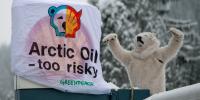
DAVOS, Switzerland (AP) — Activists with a big fake polar bear have occupied a Shell service station in the Swiss resort of Davos to protest Royal Dutch Shell PLC's oil drilling in the Arctic.
About 25 activists from around Europe chained gas pumps together Friday at the station near where the World Economic Forum was being held and hung a banner on the roof reading "Arctic Oil - Too Risky."
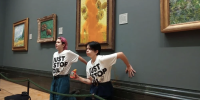
On Friday, in room 43 of London's National Gallery, two young women opened cans of tomato soup and threw their contents onto Vincent van Gogh’s famous painting Sunflowers. The soup-throwers donned shirts displaying the logo of Just Stop Oil, an activist group that has been staging nonviolent demonstrations across the United Kingdom to protest the production of fossil fuels.
Hundreds of thousands of people worldwide marked the International Day of Zero Waste, which spotlighted solutions to the mounting environmental and social problems caused by the fashion and textile sector.
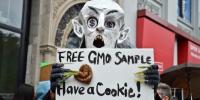
MonsterSanto extolls the virtues of GMO's while his Money Head Clones offer the crowd free samples. President Bomblast entertains the crowd attempting to juggle Peace, Jobs, and Truth. A food fight breaks out.
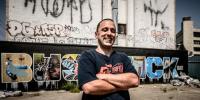
Conceived and curated by Bushwick native Joe Ficalora, the Bushwick Collective has evolved into an extraordinary open-air gallery since its first mural surfaced in 2011.
Attracting a wondrous array of local, national and international artists, it showcases first-rate street art -- from legendary Blek Le Rat stencils to huge collaborative walls by such world-renowned artists as Case Ma'Claim and Pixel Pancho.
The 21st annual Environmental Film Festival is being held in Washington DC from March 12 to March 24, 2013. Shining a spotlight on environmental issues and eco-activism, the festival features films that are both directly and tangentially related to concerns for the natural world.