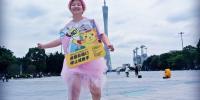
“Rose Boy” (玫瑰少年) refers to Yeh Yung-chih, a 15-year-old junior high school student in Taiwan who died on April 20, 2000, after years of bullying due to his non-conforming gender expression. Though the official cause of death was ruled accidental—he allegedly slipped in a school bathroom—the circumstances surrounding his death, including prior complaints from his mother about repeated verbal and physical harassment, drew widespread public attention.
In 2016, Zhou Zhenfeng, who was a student at a college in Hebei at the time, discovered that there were a lot of waste tires in the streets and alleys. Zhou Zhenfeng learned that tires are made of infusible or refractory polymer elastic materials. It takes hundreds of years for these materials to decompose in the soil to the extent that they do not affect the growth of plants.
The world is shocked by China’s dog meat festival and by videos showing that animals are eaten alive in restaurants in Guangdong. But in that country of 1.3 billon people, a massive shift in ideology is happening. Our friends at PETA Asia are helping millions of people see that animals are not ours to eat, wear, experiment on, use for entertainment, or abuse in any other way.
By Steven Jiang, CNN
https://www.cnn.com/2018/03/14/asia/china-viral-eye-roll-intl/index.html
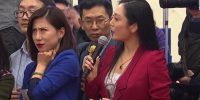
(CNN)It was the eye roll that resonated with millions -- and broke the internet in China.
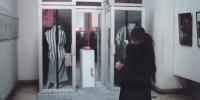
Xiao Lu was one of the most influential women in contemporary Chinese art, better known for provoking performance art works and sharp social commentaries. Her works address sensitive social and cultural issues that counter mainstream attitudes and values. In 1989, she put her work "Dialogue" up for exhibition at the National Art Museum of China in Beijing.
Two pairs of dusty, pastel-orange roller skates. A ram's skull. Several meters of tangled, bright red rope. They aren't the sort of items you'd find in the great fashion houses of Europe or on North American catwalks.
But, for unconventional Chinese designer and performance artist Wan Yunfeng, they are perfect.
From his small apartment in eastern Beijing, Wan makes fashion that only he wears.
Zhang Huan is a very talented performance artist in China. In the famous work "Twelve Square Meters", he was covered with fish oil and honey sitting in a dirty public toilet in Beijing's East Village for an hour, not only making swarms of flies greedily surround him, but also People feel extremely uncomfortable and even nauseous.
China's "Punchline Queen" Yang Li is no stranger to controversy.
The 29-year-old is now one of the country's most well-known comedians, having risen to fame in recent months on a Chinese television show called "Rock and Roast".
Every week, in front of a national audience of millions, she addresses controversial gender issues using a style unfamiliar to many Chinese viewers - stand-up comedy.
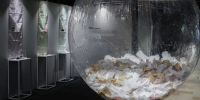
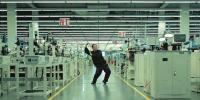
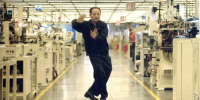
Whose Utopia? is a color film which is 19 minutes 58 seconds long. It was originally commissioned by the Siemens Arts Program back in 2005. The projector-style video is based on the work and social lives of assembly line workers at OSRAM’s light bulb factory in the Pearl River Delta in China. This area has received huge numbers of immigrants from inland provinces seeking work and better lives in the wake of Beijing’s booming economy.
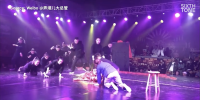
A viral video of a student dance performance in southern China’s Guangxi Zhuang Autonomous Region has won praise for speaking out against so-called ghost marriages, which many today see as an archaic and even dangerous tradition.
"100 Questions About Sex from Children" is an annual touring sex education exhibition founded and curated by Se A, a leading advocate of inclusive sex education in China. Since its launch in 2021, the exhibition has been held in major cities such as Shenzhen and Guiyang, with plans to expand into regions where sex education and gender awareness remain underdeveloped.
Leilei Zhang was harassed on a public bus when a man gripped her hand, glared at her and refused to let go. With the determination to raise public awareness, Leilei began a crowd-funding campaign to raise money for what could have been China's first public anti-sexual harassment advertisement. She approached the authorities of her home city, Guangzhou, but it did not want to take on the advertising for fear it would panic the public.
Whose Utopia? was made by the Chinese artist Cao Fei and filmed at the OSRAM lighting factory in Foshan in the Pearl River Delta in southern China during 2005 and 2006. It was commissioned as part of a project entitled ‘What Are They Doing Here?’ that was run by the Siemens Art Program from 2000 to 2006 and involved Chinese artists undertaking six-month-long residencies at industrial facilities across the country.
In 2009, the dissident artist created a work to honour the thousands of children who died in the Sichuan earthquake. He recalls how the project, Remembering, angered China’s rulers – and changed his career for ever
This is an edited extract from The Start podcast