change
region
medium
issue
Anton
In 2016 an eye-catching sparrow was spotted in Scotland. The bird had ingested feed pellets from a nearby salmon farm, turning its feathers pink. Cramped in underwater feedlots, farmed salmon have no access to the prey that colour their flesh in the wild. Instead, they are fed artificial colourants mixed with supplements, drugs, and hormones, causing them to relentlessly produce the additive-filled flesh that fills supermarket shelves. The environmental degradation caused by open-net fish farms (not only salmon, but also sea bream, sea bass, tilapia and shrimp) can be observed in areas far from the dead zones created around the farms. Making fish feed requires krill from the Arctic, sardines and anchovies from the coast of Peru, India, Western Sahara and Senegal, and soy from Argentina and Brazil, where vast swathes of land are being deforested to provide space for agriculture.
Open-net fish farms release excrement, antibiotics, and parasites into the sea, depleting marine ecologies. In a season of polluted waters, CLIMAVORE promotes the transition to alternative aqua-cultures through ingredients that filter and oxygenate the ocean.
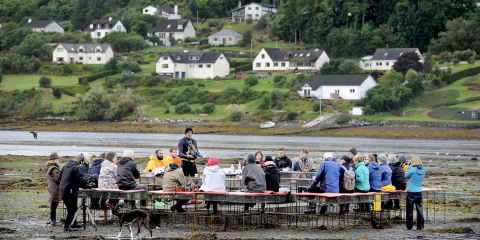
As an alternative, CLIMAVORE creates intertidal systems to produce food while also cultivating diverse marine habitats. By filtering seawater as they breathe, bivalves break down and reabsorb waterborne toxins. One mussel is able to filter up to 25 litres of water a day and a single oyster up to 120 litres. Seaweeds, meanwhile, are like trees, oxygenating their surroundings. All of these ingredients provide easy-access protein without the need for irrigation, fertilisers, medication, or colouring. Divesting from salmon farming requires shifting to intertidal foodways that nourish both people and the coast.
From: https://www.climavore.org/stations/isle-of-skye-and-raasay
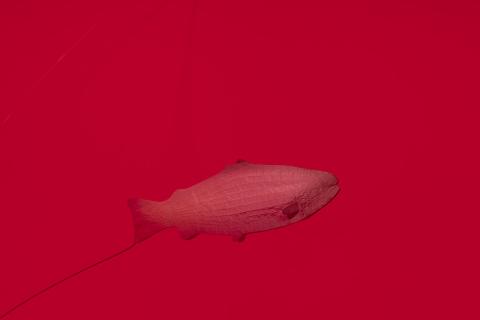
Authors of the CLIMAVORE project, artist duo Cooking Sections works on environmental restoration through artistic practices. In 2020 they presented at Tate Britain (London) the performative installation "SALMON: A RED HERRING". What follows is the artist statement of the exhibition and what followed: "The first chapter of the trilogy When [Salmon Salmon [Salmon]] begins by unravelling the deceptive nature of salmon—as both a colour and a fish. Commonly associated with a pink hue, ‘salmon pink’ is a misnomer when it comes to farmed salmon, which are naturally grey. To align their appearance with consumer expectations, synthetic pigments are added into their feed. The resulting colour varies not only by the fish’s metabolism but also by regional market preferences. In Europe, lighter pink tones dominate, while in Japan, a richer, darker pink is favoured.
Salmon is the colour of a wild fish that is neither wild, nor fish, nor even salmon. But they are not alone. The changing tones of many other species are warning signs of an environmental crisis, where the colours of life—flesh, scales, feathers, skin, leaves, wings—are increasingly altered by synthetic substances ingested and absorbed by organisms. These shifts are both symptoms and signals of profound ecological and metabolic transformations around and inside us. Salmon: A Red Herring interrogates the colours we expect in ‘natural’ environments, compelling us to confront how human interventions distort the perception of colour as we change the planet.
First exhibited at Art Now, Tate Britain, the project catalysed the removal of farmed salmon from Tate menus across all its four sites, replaced with climavore alternatives."