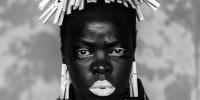
In the portrait Bester I, Mayotte, the sitter’s eyes stare directly at the camera, practically boring a hole in the lens. Their lips are painted white, their hair and ears adorned with clothespins. The self-portrait of Zanele Muholi is striking on its own, but it does not stand alone.
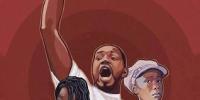
Activist Boniface Mwangi on confronting corruption in his homeland, and director Sam Soko on recording his campaign
Kenyan director Sam Soko’s debut documentary feature, Softie, opens with the film’s protagonist, Boniface Mwangi, sourcing 1,000 litres of pigs’ blood. “I’ve found a van for you. When do you want it? When are you getting the blood?” Mwangi asks.
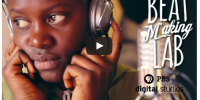
It started as an experiment: what happens when you equip a vibrant youth community with the resources to express themselves through hip hop and electronic music? Last summer I traveled to Goma, Democratic Republic of Congo to find out and the results were more beautiful than I could have imagined.
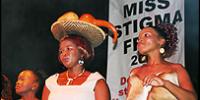
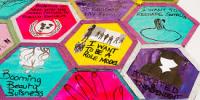
To change Bostwana’s regional misconceptions about HIV, Kesego Basha-Muebli, founded the Miss HIV stigma free pageant. A pageant designed for women who are currently receiving health and wellness counseling and HIV antiretroviral treatment to come out to their friends and family as being HIV positive.
Fespaco is a meeting place put to good use to promote the development of black cinematography. From 1973, topics of discussion are introduced at each edition.
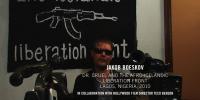
By 2010, the Nigerian film industry, also referred to as “Nollywood,” had become the second-largest film industry in the world. Today, the accessibility of digital video technology continues to enable prolific amateur filmmakers to produce wildly popular low-budget and direct-to-DVD films, which deal with timely issues of religion, poverty, and corruption.
Driving along an ordinary dirt road, it's hard to miss the Goma Cultural Centre with its bright blue gate, emblazoned with the Congolese flag. "As you can see, we are proud to be Congolese around here," said Belamy Paluku, a volunteer manager at the youth centre.
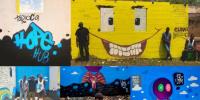
As part of the commemoration of this year’s World Art Day (April 15), Ghanaian-based Tapioca Foundation and Imposters Art Collective have embarked on a campaign to educate the public about environmental sustainability.
The project, which was launched in Ada in the Greater Accra Region, is intended to use art pieces to highlight issues relating to environmental protection and climate action to boost awareness in local communities.
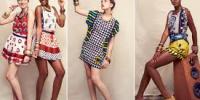
SUNO is one of the few luxury fashion brands that has been born out of a social cause. Max Osterweis and designer Erin Beatty launched their first collection in the spring of 2009, " after post-election violence threatened to damage the economy and industry in Kenya."
While the clothes is mostly produced by local artisans in Kenya, Suno has since expanded its business to include production in Peru, India, and NY.
As massacres, civil wars, and violence permeated communities, people have searched for asylum in other countries. Due to its location and relative safety, Spain has become a common destination for immigrants seeking a better life. Female immigrants in particular tend to experience much more arduous journeys in that they frequently are subjugated to sexual abuse.
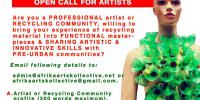
Afrika ARTS Kollective is a group of artists that decided to face Uganda's demographic growth and the garbage problem of the capital, Kamala, with art. 30,000 tons of residues come out of this monthly and the Administration is being working on healthy and good environmental behaviors among citizens.
WACENA, was established in the year 2008 by a number of concerned mothers together with women students from Makerere University Kampala with a purpose of addressing and alleviating the acute and long-term consequences of violence against the women and children of Uganda.
At the age of just 30, Palesa Ngwenya is helping transform these areas through her position as development coordinator of Maboneng Township Arts Experience. “We turn homes in the townships into art galleries,” says the young South African woman, who grew up during apartheid. “It’s about showing people that you can use what you have to do things that can change your life."
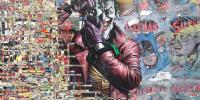
A Côte d'Ivoire-based artist, known as Kadarick, draws on the fantastical powers of The Hulk, Spiderman and Wonder Woman to articulate today's fears.
In a new pop-art series of 23 paintings titled Joker, the self-taught painter explores pop culture, politics, mass media and capitalism. The series was recently on display at the LouiSimone Guirandou Gallery in Abidjan.
In the Democratic Republic of Congo or DRC, sexual violence is a community-wide problem. Rape, in the DRC has been used as a weapon of war and sadly continues to increase even after. According to the peacebuilding NGO Search for Common Ground or SFCG, it is estimated that there are over 400,000 surviving rape victims living in the DRC today. In this environment violence against women has become normative behavior.
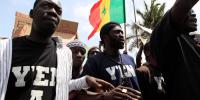
"Y’en a Marre (“We're Fed Up") first emerged in 2011 as a grassroots campaign against injustice and inequality in Senegal. Spearheaded by the hip hop group Keur Gui Crew in response to local power outages, the nascent protest movement went on to mobilize against the controversial bid by Senegalese president Abdoulaye Wade to remain in office for a third term.
One of the most pressing questions before us in the United States now is how to resolve the tension between our personal visions and needs, on the one hand, and the demands of being a member of a community, on the other.
"Puppets Against Aids was launched by Gary Friedman on 1st December 1988 in time for 'World Aids Day' in Johannesburg, South Africa. During 1987, Friedman had been studying with Muppet master, Jim Henson, in Charleville-Mézières, France. Henson provided the initial financial contribution to launch the African Research and Educational Puppetry Programme 'Puppets Against Aids'.
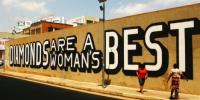
Africa has had a devastating history of blood diamond wars. Blood diamond refers to a diamond mined in a war zone and then sold to finance an invading army's war efforts, usually in Africa where more than two-thirds of the worlds diamonds are extracted.
This site specific social / political word play was painted on the exterior wall of Johannesburg's largest diamond trader Jewel City.
The Rwanda Film Institute dedicates a lot of its energy to the education of individuals in the field of filmmaking. Through our Kwetu Film School, we look to consistently breed the next generation of Rwandese filmmakers. This is an essential part of our overarching goal of the development of Rwanda culturally, economically, and communicatively through the growth of filmmaking as an industry.
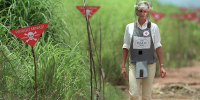
It's an evocative image — and it was intended to be: Diana, Princess of Wales, wearing a protective visor and flak jacket, walking through a live minefield in Huambo, Angola. The image of the princess, at the time one of most famous women in the world, surrounded by danger, made headlines across the world.
Drama Queens Ghana's “MoonGirls” is an Afrofuturistic graphic novel series. Through an Afrofuturistic lens, “MoonGirls follows the adventures of 4 African "supersheroes" with varying superpowers to save the world from a diverse range of forces; from patriarchy, rape culture to pollution and global warming.
In 2004, the United Nations called the LRA crisis in northern Uganda the “most forgotten, neglected humanitarian emergency in the world.” Invisible Children was founded to change that and to fight against the false notion that our responsibility to each other stops at our own nations’ borders.
Photographer Thapelo Motsumi is one of many young South Africans who has worked with the Umuzi Photo Club to develop his artistic skills and engage his community. Now this “drop out” has had two exhibitions in London and has been entrusted with Mandela’s football jersey. By GREG NICOLSON.