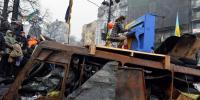
In Kiev, clashes between protestors and police have persisted since December. Blood has been shed, and the political stability of Ukraine remains uncertain.
During late January and early February, the opposition began to play music (from pianos) in front of riot police. These artists modus operandi has been to serenade protestors and police toward peaceful consensuses.
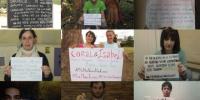
The "no nos vamos, nos echan" campaign speaks to making the invisible visible through pictures, videos and global mass demonstrations. Hopefully the Spanish government and other political players in Spain and Europe will see the faces of the population forced in exile.
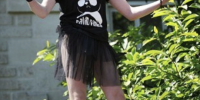
"What the Skirt Lifts", created by a student in France, is a day long protest against gender discrimination where male and female students were encouraged to wear skirts to school.
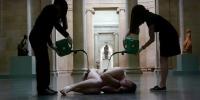
On 8 March 2014, International Women’s Day, several female activists (Amina Sboui, Aliaa Magda Elmahdy, Solmaz Vakilpour, Safia Lebdi, Meriam Russel and Maryam Namazie) protested nude in support of women’s rights in the Middle East and North Africa in front of the Louvre pyramid in Paris.
Showcasing death to defend life
El Pais, Madrid
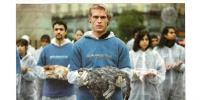
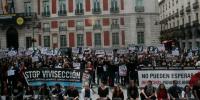
Activists protested with the organization Animal Equality (Igualdad Animal) in Puerta del Sol, Madrid, Burgos, and Toledo on December 10, commemorating the international Animal Rights Day.
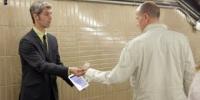
Un hombre trajeado viaja en el Metro. Utilizando frases clásicamente asociadas a la mendicidad, las invierte. En vez de anunciar precariedad económica y un estado de necesidad, afirma ser un banquero, sin cargas familiares, que no está perseguido por la justicia. Ofrece monedas a los viajeros, diciendo que si las cogen, ello le hará sentir mejor.
Empathy may be the cornerstone of any Global Justice movement, but how do we cultivate the conditions for empathy to thrive?
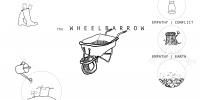
The wheelbarrow symbolises something universally useful, practical and pleasingly straightforward. A space to deliver things in an efficient and direct manner - no packaging and completely people powered.
Gender equality charity Women of the World (WOW) is launching a one-day festival of activism that invites people from all generations, genders and backgrounds to take part in conversations around sexual violence.
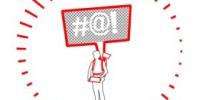
The KLE - Kit de Libertad de Expresión (or Freedom of Speech Kit), is a portable digital device that allows people from all over the world to participate to remote protests by sending and displaying text messages in public space. The interactive banner is (unsurprisingly) inspired by the record number of social protests that took place in Spain in 2011. It is estimated that over 23.000 demonstrations have been organised that year around the country.
Play Safe is a documentary film series created and directed by NYU alum Eddie Einbinder. The film, much of which now appears for free on YouTube, was originally released in 2013 after being filmed between 2011 and 2012. It debuted at the International Harm Reduction conference in Vilnius, Lithuania in 2013.
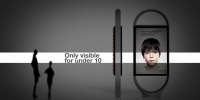
In an effort to provide abused children with a safe way to reach out for help, a Spanish organization called the Aid to Children and Adolescents at Risk Foundation, or ANAR for short, created an ad that displays a different message for adults and children at the same time.
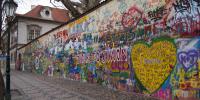
Prague's Lennon Wall is a tourist attraction to some, and a participatory street art haven for others. Directly opposite of the French embassy, the wall has been filled with evolving art and graffiti since the 80s. The wall received its first public inscription, a tribute to John Lennon, following Lennon's assassination in September 1980.
Founded in 2008, the French Feminist Collective, La Barbe, targets inequities of female representation in media and cultural/governmental institutions. La Barbe, meaning "beard" in French, is also an old colloquial expression for "enough is enough!". Known as barbues, the female members are all ages. Any woman is welcome to join.
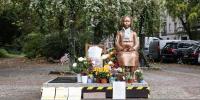
Photo taken on Oct. 15, 2020 shows a "comfort women" statue in Berlin, capital of Germany. The statue was built to commemorate the more than 200,000 girls and women from 14 countries and regions, so-called "comfort women," who were sexually enslaved by the Japanese military during World War II. (Xinhua/Shan Yuqi)
On April 23rd, in commemoration of the International Day for Animals in Laboratories, Animal Equality's activists in Rome, Madrid, Barcelona and many other cities across Europe carried out demonstrations against animal testing.
In 2012, VOW Media worked with young girls - who have been victimized by, or are at the risk of falling victim to “loverboys”, as well as girls who have gone through severe traumatic experiences, such as repeated emotional, physical and/or sexual abuse – in a series of workshops where they learned how to utilize different forms of media to create their very own self-portrait with photography, radio, and video.
This week, I got to make history. At 18 years of age, I received an honorary doctorate from the University of London for my work in climate justice, making me the current youngest holder of the award globally.
Theater as investigative reporting or investigative reporting as theater, however you cut it, Mark Thomas, a British TV actor/comedian and activist has created a fascinating show. It's by him and about him: how he ran stings that put some illegal arms traffickers out of business or in jail and how he was deceived and betrayed by a "comrade" who turned out to be a spy for BAE Systems, the UK's largest aerospace and weapons company.
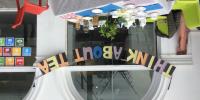
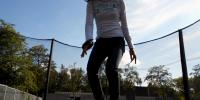
We built a conversation space where members of the public were invited to enjoy a free cup of tea. We used a vertical garden which spelled out the word 'TEA' in easily available plants and herbs that can be used to make tea.
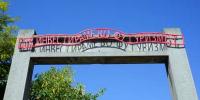
A site specific intervention аs part of the group exhibition Sculptural, organized and partly financed by the Museum of Contemporary Art, Skopje. The text INVEST IN FUTURISM is a quotation of a gaffe uttered by the Macedonian PM on public TV stating his plans to incorporate contemporary art in their right wing populist programme and the infamous project Skopje 2014.
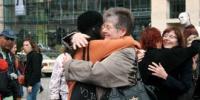
On the afternoon of September 11th, nearly a hundred people hugged each other to feel the beauty of the hug on the Paris Square in front of the Brandenburg Gate in Berlin, under the leadership of the Chinese artist Gao Brothers. At the beginning of the event, the Germans have not yet adapted to the behavior of embracing strangers, but encouraged by Gao brothers, people have opened their arms and gave the strangers around them a warm hug.
Her name is ISIS-chan. And she's how nerds around the world are trying to silence violent ISIS terrorist propaganda.
It starts with the vibrant worldwide community that loves Japanese anime. Some of them have created a cute animated character as a sort of ISIS mascot.
The goal? Hijack the terrorist group's message and replace it with a girl that's oh-so-adorable.
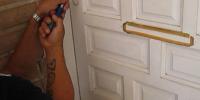
58,241 evictions were conducted in Spain in 2011, mostly through real estate speculation by the Mediterranean Savings Bank. In Intervention #1, the artist created a cooperative through which she contracted a construction worker (who himself had been evicted from his own house) to remove the entrance doors to other foreclosed properties. In this way, houses were accessible and open to public use, and occupants were not liable for housebreaking.