Senior activists clad in hospital gowns crowded the State House steps Monday and parted their johnnies to expose false rubber buttocks -- in the hopes of drawing attention to a "gap" in health care assistance for low-income seniors. The Massachusetts Senior Action Council organized the rally to push for expanding eligibility for the Medicare Savings Program, which helps seniors pay Medicare premiums and other expenses.
Eight years after his death, the annual August Wilson Monologue Competition provides high school students from around the country an opportunity to carry on the African-American playwright’s legacy. That legacy includes Pulitzer Prizes for “Fences” and “The Piano Lesson,” two installments of Wilson’s 10-play series set in his hometown of Pittsburgh that examined 20th-century black life through the personal and political struggles of everyday people.
Indigenous designers often use fashion to celebrate their culture and raise awareness around key issues affecting their community. Now, the spirit has come to the modeling world. Haatepah Clearbear is a full-time model, based in Los Angeles, who is using his platform to uplift his people. The 22-year-old’s personal Instagram page serves as a hub for his activism work, where he highlights everything from climate change to indigenous rights.
For a class project at Northern Illinois University, we were tasked with performing an act of artistic activism on campus. We choose to raise awareness about the student health insurance policy. The policy at NIU states that if you do not have your own form of insurance, you are automatically charged for the university’s insurance plan, which costs $1,224 per semester.
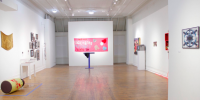
At the press preview for Sharon Hayes’s new full-floor exhibition “There’s So Much I Want to Say to You” at the Whitney Museum there was a podium and a microphone set up in the center of the gallery that would eventually be used by director Adam Weinberg and curator Chrissie Iles to introduce the artist and her restless work.
An oversized facsimile of Rush poppers, tipped over, pouring out its viscous contents: this example of underground gay iconography blown up to almost belligerent proportions perfectly represents the aims of Party Out of Bounds: Nightlife as Activism Since 1980, a new exhibition at La MaMa’s La Galleria. The group show, curated by Emily Colucci and Osman Can Yerebakan, gathers together works by a small yet distinct menagerie of queer artists.
The AIDS pandemic began in the early 1980s and brought with it a surge of emotions from the public: they were afraid, angry, fearful and defiant. The arrival of AIDS also brought with it a condemnation of the LGBT community. These emotions, along with the view on the LGBT community, paved the way for a new generation of artists.
Beating Cancer is a hard task. Cancer patients spend endless days in the hospital receiving a multitude of tolling treatments that we understand are necessary to save our lives. However, when you're a kid, it isn't always so easy to understand what's going on. As the chemo kills bad cancer cells, it also kills good cells in your body, which causes various unpleasant side effects.
"Medicine Man," a mobile sculpture that MAKE ART/STOP AIDS commissioned from San Francisco-based artists Daniel Goldstein and John Kapellas. The piece is constructed of pill bottles that Goldstein and Kapellas, and their partners, saved up from treatment regimens dating as far back as 1985. The artists assembled the bottles in the shape of the Virgin of Guadalupe, with an aureole of syringes arrayed around her body in a halo.
Last September, Fusion commissioned artist Tatyana Fazlalizadeh, 29, to travel to Mexico City and create an installation of her highly-acclaimed art project protesting street harassment, “Stop Telling Women to Smile.” Fazlalizadeh’s visit to Mexico was her first to the country; it was also the first time the STWTS project — for which Fazlalizadeh papers city streets with hand-drawn portraits of women pushing back against their street harassers — had eve
Lynn Neuman, director of New York City–based Artichoke Dance, became preoccupied with single-use disposability after she started wondering about waste and who was responsible for it. For some of her performances, she has collected massive quantities of discarded plastics, like bags and six-pack rings, and invited community members to contribute their own. “There’s a real aha moment when people see how quickly plastic amasses,” she says.
Vince Staples mentioned Long Beach's Ramona Park approximately 80 times on his debut album Summertime '06 and even allotted the park two of its own tracks: "Ramona Park Legend Pt. 1" and "Ramona Park Legend Pt. 2." "The sun come down and guns come out, you know Ramona Park."
Low-income tenants at a public housing project in Rhode Island — many of them working mothers with young children — wanted an affordable day care center in their building. With petitions, pickets, and letters to the city council, they built up a steady drumbeat of pressure on the key decision maker, the local Housing and Urban Development (HUD) director. At a certain point they decided to escalate with direct action.
The group of NYU graduate students went to bars in Manhattan to shout back against sexual harassment and bring awareness to the Everyday Sexism project. Armed with coasters that said "#shoutingback" on them, as well as a slogan. Three different coasters with three different slogans were put on bars and tables in local watering holes. The slogans included "She ordered a drink.
In the broad context of the modern world of art, the work of Beili Liu has always seemed extraordinary in visual terms and deeply profound in thematic development. Born in China and living in the United States, much of her work usually circles themes tightly interwoven with notions of identity, culture, and time.
Founded by Frankie Hutchinson, Emma Burgess-Olson and Christine Tran, Discwoman is a New York-based platform, collective, and booking agency—representing and showcasing cis women, trans women and genderqueer talent in electronic music. Started as a two-day festival in September 2014 at Bossa Nova Civic Club Discwoman has since produced and curated events in 15+ cities—working with over 150 DJs and producers to-date.
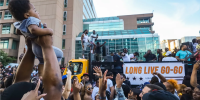
In response to white gentrifiers trying to silence go-go music on the corners of Florida Avenue and 7th Avenue, activists and D.C. residents poured into the streets by blasting go-go music and celebrating its rich history within the city. For those unfamiliar, go-go music is at the heart of D.C. culture and features live bands playing covers of, and sometimes original, music with all different types of drums and other percussion instruments.
When Behnaz Babazadeh was young, her family moved from Afghanistan to the US. She loved almost everything about her new home — especially America’s amazing selection of candy — but she also loved wearing her familiar pink-flowered headscarf, which she’d grown used to wearing as part of her school uniform in her old home.
On a sidewalk in the Village in downtown Manhattan, an African-American woman leans on her elbows and knees, wearing only black underpants. Scrawled in black marker all over her body are the words "Ain't I a Woman?"
Across the street, another woman lies face down, sunbathing on a large sheet of tinfoil. The sentence "White Supremacy Is Terrorism" is inked across her white skin, which is turning pink under the hot sun.