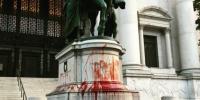
Just weeks after activists staged an alternative tour of the American Museum of Natural History to call for its removal, among other things, the equestrian statue of Teddy Roosevelt was vandalized early Thursday morning.
In June of 1987, a small group of strangers gathered in a San Francisco storefront to document the lives they feared history would neglect. Their goal was to create a memorial for those who had died of AIDS, and to thereby help people understand the devastating impact of the disease.
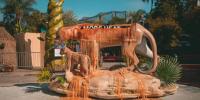
American artist Bob Partington created a wax sculpture of a Florida panther and her cub to display at a nonprofit zoo in Tampa, Florida this September.
When it debuted, the sculpture looked like nothing special. But as the wax began to melt under the heat of the sun, the bodies of the endangered species started to disintegrate. Within a couple days, the mother panther’s melting body revealed a simple message: “More heat, less wildlife.”
Scrawny. Short. Ugly. Fat. Weird. 30% of school kids worldwide are bullied each year and bullying is the #1 act of violence against young people in America today. The BURGER KING® brand is known for putting the crown on everyone’s head and allowing people to have it their way. Bullying is the exact opposite of that. So the BURGER KING® brand is speaking up against bullying during National Bullying Prevention Month 2017.
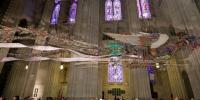
Xu Bing, the internationally acclaimed Chinese artist, has brought his “Phoenix” installation to the majestic nave of the Cathedral Church of St. John the Divine on Manhattan's Upper West Side. The two phoenixes, both Feng, the male, and Huang, the female, faced the decoratively carved bronze doors of the Cathedral, as if poised to take flight in the middle of the night.
A major exhibition by Ai Weiwei this autumn features a new series of monumental sculptural works in iron, cast from giant tree roots sourced in Brazil during research and production for last year’s survey exhibition, ‘Raiz’, at the Oscar Niemeyer-designed OCA Pavilion in Ibirapuera Park, São Paulo.
From an article in BoredPanda:
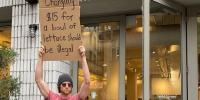
"If you’ve ever felt like your voice and opinion doesn’t matter in the vast world, then Seth is here to prove you wrong. This New Yorker runs the ‘Dude With Sign’ Instagram account where he uploads photos of himself protesting the strangest, weirdest, most random things. And the best thing is, we can relate to most of what he’s written on his signs.
How it works:
1. Call or text “hello” to (951) 963-3643 to share your experience. Make sure you’re in a quiet place. Maximum recording time is 10 minutes.
2. Please start by telling us where you’re calling from. Perhaps you can even paint a picture of your surroundings for anyone who listens. Then share what you want to say.
3. Hang up when you’re finished.
Is there a way to make sex ed, big, scary, nasty, icky, sex ed, fun again? In the Spring Quarter of of 2013, UCLA students in the Sex Squad, a performance troupe dedicated to injecting a dose of humor into high school sex education, set out to answer that question through a series of short videos.
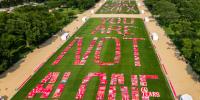
The Monument Quilt is a large quilt that serves as a memorial for survivors of rape and abuse. It contains over 3,000 stories from individuals who have experienced gender-based violence, and allows visitors to add their own stories by writing, painting, or stitching onto red fabric. The project took place over a span of six years, during which the organizers traveled to 49 states and 33 cities in the U.S.
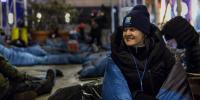
Covenant House has started a ‘Sleep Out’ movement that shines light on the youth homelessness crisis and raises funds for young people who seek shelter. "Covenant House empowers young people to overcome homelessness and trafficking by providing them with safe housing, food and clothing, and relentless support. Sleep Out events are held for people who want to join the movement as they give up their bed for one night in NYC.
The artist in close collaboration with AMI (Assembly of Indigenous Migrants of Mexico City) has created a series of monographs made by students, through ‘tequio’: a communal system of organisation expressed in collaborative practices, mandatory and unpaid work. The goal of the project is to offer information about the lifestyle and culture of these indigenous communities, which live in Mexico City.
"The Surveillance Camera Players (SCP) is a small, informal group of people who are unconditionally opposed to the installation and use of video surveillance cameras in public places.
For an art project about the effects of white privilege and the disturbing ways in which its effects are built into our society, Risa Puno’s The Privilege of Escape is a surprisingly fun, even enjoyable experience.
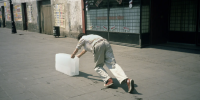
What is Francis Alÿs known for?
Francis Alÿs is known for using poetic and metaphorical techniques to highlight the political and social realities of his city. Often, the issues he addresses range from national border politics to globalism and areas of conflict in his community and the effects of modernism.
In Jan. 2016 Karl Mattson from Rolla, BC displayed some of his unique sculptures for exhibition at Lantern Gallery in Winnipeg, Manitoba. His 'Life Pods' are sculptures constructed using only found objects.Tools, metal fragments, debris, and fuel tanks are some of the components welded together forming both the solo pod, and the family size pod. The larger pieces were acquired near the pipeline embedding site near to his farm.
To bring attention to the widespread apathy toward climate change, nonprofit group 350action and agency Barton F. Graf 9000 got a little personal. Tapping into the meteorological legacy of naming hurricanes after people–thereby marring the good names of unsuspecting Sandys, Irenes and Katrinas everywhere–“Climate Name Change” told the same storm story, but subbed in the name of prominent politicians who refuse to acknowledge climate change.
Call it art, exhibited as an installation piece in the October 2014 show "Crossing Brooklyn," a collaboration of more than 100 artworks by 35 artists (or groups) who live or work in Brooklyn, presented at the Brooklyn Museum... or call it "A survey of Art from Brooklyn" as hyperallergic journalist Jillian Steinhauer wrote... it exists on the streets as a social practice, albeit using creative means for community-building.
Activists are working to bring a steel sculpture of a 45-foot-tall nude woman to Washington, where she will temporarily face the White House from a perch on the National Mall.
Transporting the sculpture from its home in San Francisco will be an undertaking, but its artist, Marco Cochrane, said he saw it as an opportunity to start a conversation about violence against women.
https://vimeo.com/114980972
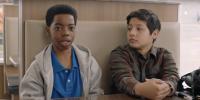
"Probably one of the most important and timely shorts for America this year. Reinaldo Marcus Green's film addresses the upsetting aspects of New York City's stop-and-frisk policies with sensitivity and insight."
-Jeff Bowers, VICE (http://bit.ly/1mU7HHQ)
Zimmerman a composer who uses art, dance, tech, and even robots in his shows. You might call this interdisciplinary. Wagner called it total art, or gesamtkunstwerk.
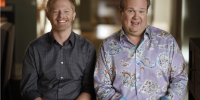
‘Modern Family’ Finale: How Cameron and Mitchell Forever Changed Gay Families on TV
The groundbreaking ABC sitcom came to a conclusion this week, forever leaving its mark on the LGBTQ television landscape.
Jude Dry
Apr 10, 2020 5:00 pm
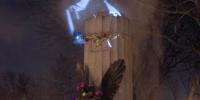
While most people slept, a trio of artists and some helpers installed a bust of NSA whistleblower Edward Snowden in Brooklyn on Monday April 6. They fused it to part of the Prison Ship Martyrs Monument, a memorial to Revolutionary War soldiers. By later that day, officials had removed the bust. But then a group called The Illuminator art collective replaced the missing bust with a hologram projection of Snowden.
Following the backlash of Netflix's support of Dave Chappelle's "The Closer" comedy special, which featured racist transphobic "jokes", Hannah Gadsby took a deal with Netflix to create a comedy special featuring genderqueer comics. The show, titled 'Gender Agenda', was tapped in the Alexandra Palace Theatre in London and released on Netflix on March 5, 2024.