Immersing in the art is what they are known for. As they slowly reopen, so is their annual public art and performance festival. Their mission statement says:“AiOP reminds us that public spaces function as the epicenter for diverse social interactions and the unfettered exchange of ideas.” The title of NORMAL is to push the boundary of what is.
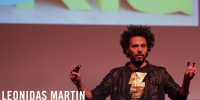
Enmedio member Leonidas Martín at Creativetime 2012 (New York). His presentation “How to Disrupt the Financial Order with Humour, Creativity and a Dose of Mischief” is priceless. Watch the video and laugh.
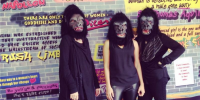
It’s women’s history month, and your favorite radical feminist avengers want you to go ape. The Guerrilla Girls have been making noise about gender and racial inequality in the art world since 1985. Fighting discrimination with a sense of humor and their signature faux fur, these masked feminists continue to challenge major museums to spotlight more women and artists of color.
A group of unidentified guerrilla activists staged a unique pro recycling flashmob in a Quebec mall in July 2015. An actor 'forgot' an empty water bottle on the ground in a food court a couple of feet from a recycling receptacle. Numerous people walked past the bottle and did nothing. Finally a woman walking past it reached down and recycled the bottle. She was then given a standing ovation and thunderous applause from the entire food court.
(Honoring our Origins, Ourselves and our Dreams) is an all-womyn and womyn-identified crew from the northeast San Fernando Valley dedicated to creating awareness through public art.
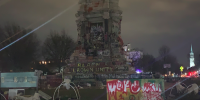
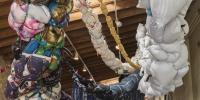
Over the winter break, I was actually able to see the recently re-decorated Robert E. Lee statue in Richmond, Virginia. After the height of the Black Lives Matter Protests over the past summer, it couldn’t be torn down, but it was fully wrapped with protest art. All phrases and slogans (such as Black Trans Lives Matter, ACAB, Etc.) were in full display over the statue of the infamous Confederate General.
Before it was called the Downtown Arts District, many more artists lived and worked in this stretch of central Los Angeles. The neighborhood was a rough-edged alternative for people in need of large, industrial spaces. A home for those willing to be Skid Row-adjacent and amenity-non-adjacent. But Los Angeles is making an attempt at urbanization, at feeling like a much denser city, and rapid gentrification has followed.
Drag Out The Vote™ is a nonpartisan, nonprofit organization that works with drag performers to promote participation in democracy. We educate and register voters at drag events online and offline, by organizing local and national voter activations. Led by fierce drag kings and queens across the nation, we advocate for increased voter access and engagement in 2020 and beyond.
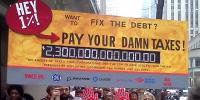
On Monday, a grassroots, anti–corporate tax-dodging coalition called Flip the Debt crashed a "Fix the Debt" party at St. Anselm's College in New Hampshire hosted by Honeywell CEO David Cote to tell the gathered deficit hawk disciples that paying their "damn taxes" would be a better solution than crippling the nation with fiscal austerity measures.
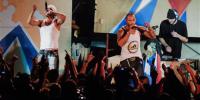
HAVANA (AP) — A U.S. agency's secret infiltration of Cuba's underground hip-hop scene to spark a youth movement against the government was "reckless" and "stupid," Sen. Patrick Leahy said Thursday after The Associated Press revealed the operation.
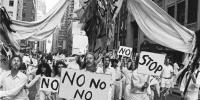
This year marks the 50th anniversary of one of this country’s most beloved theater companies. Founded in New York City in 1963, the Bread and Puppet Theater’s first productions ranged from puppet shows for children to pieces opposing poor housing conditions. The group’s processions, involving monstrous puppets, some about 20 feet high, became a fixture of protests against the Vietnam War. "We don’t have playwrights in the theater.
DEL AIRE, Calif. — Fruit looms large in the California psyche. Since the 1800s, dewy images of oranges, lemons and other fruits have been a lure for seekers of the state’s postcard essence, symbols of fertile land, felicitous climate and the possibilities of pleasure.
The rap duo Macklemore and Ryan Lewis has broken records with their hits “Thrift Shop” and “Can’t Hold Us.” And now, with their pro-marriage equality hit “Same Love,” which features out lesbian Mary Lambert, they’re shattering stereotypes.
AMNA NAWAZ: Since anti-government protests erupted in Iran last year, people around the world have taken to social media to show their support.
That includes an Iranian American ballerina who's tapping into her own heritage and her art, in solidarity with those pushing for more rights.
The "NewsHour"'s Julia Griffin reports for our arts and culture series, Canvas.
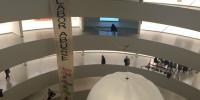
A thirty-nine-foot banner was unfurled in the rotunda of a sparsely-attended Guggenheim Museum this evening, the latest action carried out by the Gulf Ultra Luxury Front (G.U.L.F.) activist group. Decrying labor abuse at the museum’s planned Abu Dhabi outpost, the banner announced the forthcoming “Countdown” campaign by Gulf Labor, the larger collective of artists and activists of which G.U.L.F. is an offshoot.
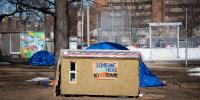
On his way to work on a construction site, Khaleel Seivwright surveyed the growing number of tents lining an intercity highway and in parks with increasing discomfort. How would these people survive Toronto’s damp, frigid winters, let alone the coronavirus, which had pushed so many out of overcrowded shelters?
He remembered the little shanty he had once built out of scrap wood while living on a commune in British Columbia.
Sometimes justice requires a little imagination. On Saturday, when
much of the Occupy Wall Street movement in New York was loudly
denouncing police violence against minorities and protesters, a small
group of environmentalists dreamed up a way to get the police to focus
on the crimes of the 1 percent, to the point of arresting five corporate
suits on United Nations property.
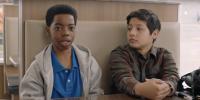
Scrawny. Short. Ugly. Fat. Weird. 30% of school kids worldwide are bullied each year and bullying is the #1 act of violence against young people in America today. The BURGER KING® brand is known for putting the crown on everyone’s head and allowing people to have it their way. Bullying is the exact opposite of that. So the BURGER KING® brand is speaking up against bullying during National Bullying Prevention Month 2017.
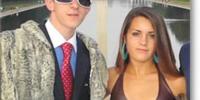
Trickery and disguise, usually followed by revealing the truth, are often tactics used by liberal activism, like the Yes Men for example. When used by the right, however, it can have different implications. Pretending to be a CEO or billionaire in order to expose corporate greed and corruption is clearly different then pretending to be a minority. The use of disguise can manipulate and shed light on hierarchies of power.
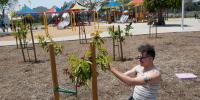
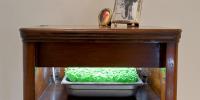
"Jenna has designed an efficient, sub-irrigated system for growing
energy-packed plants (microgreens) in small, urban spaces. Her aim: to
provide healthy greens to extraordinary people with ordinary incomes.
As an urban agricultural design project, she envisions a way to
grow food in an anthropogenic landscape for all strata of citizens, but
as an art project, she hopes to facilitate conversations about
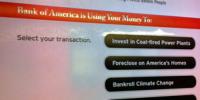
A couple of weeks ago, a group of activists working with Rainforest Action Network’s Energy and Finance campaign hit the streets of San Francisco to bring a little truth about Bank of America’s misdeeds to its customers—not in the lobbies of the bank’s local branches, but at its ATMs throughout the city.
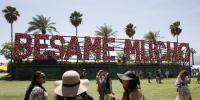
Has the Coachella Valley Music and Arts Festival, long a bastion of high-priced fun-in-the-sun escapism, finally sharpened its political teeth? A few of this year's art installations would say yes, as Coachella during this election year doesn't seem to be going quietly into the cultural void.
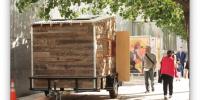
The project consists of a small mobile workspace and a micro artist residency program composed by two tiny art studios founded in Oakland. Studio 1 is a solar powered art studio which was built on the back of a flatbed trailer and Studio 2 was built in collaboration with students at Stanford University, both spaces are composed of second-hand materials.
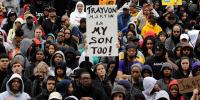
I was just shy of 18 when I bought the hooded sweatshirt — a metallic silver thing that cost about $10 on the Aeropostale clearance rack — to take with me to Northwestern University in the Chicago suburbs, knowing my parents would be worried when they saw it.