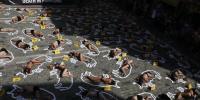
In 2019 before the annual San Fermin festival 54 protesters from around the world representing AnimaNaturalis and PETA held a demonstration against the cruel sport of bullfighting. The celebration of culture and religion subsequent to the murder and torture of dozens of bulls is the spectacle of San Fermin that draws an army of international tourists to the small city of Pamplona.
According to the Men's Rape Prevention Project in Washington DC, 58,000 soldiers died in the Vietnam war. During that same period of time, 51,000 women were killed mostly by men who supposedly loved them.
Parió Paula is an all women’s percussion group based in Lima, Peru. These women are truly artistic renegades defying the social norms of Lima’s predominantly male music scene. With a bold message on emphasizing female expression, these ladies have transformed their countless styles of drumming into something effective for their city.
(see full article and short documentary at link below)
The Free Breakfast for School Children Program was initiated at St. Augustine's Church in Oakland by the Black Panther Party. The Panthers would cook and serve food to the poor inner city youth of the area.
In response to shootings across the United States, and in sympathy with students’ demands for more gun control, artist Jenny Holzer wrote text that animates issues of the firearms industry and gun violence. Her hyperactive black-and-white writing flashed on mobile LED screens, with text popping in quick succession like free-association poetry, and sometimes in the awful rapid-fire of semi-automatic weapons.
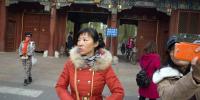
The Breath of China is a thematic photo exhibition of thousands of air-quality images taken by 44 photographers in 34 Chinese capital cities. The exhibition was displayed on the 14th Pingyao International Photography Festival (PIPF) in Shanxi Province, from September 19th to 27th, 2014.
Sarah Silverman Wants to Pop Your Bubble
With her new political variety show, “I Love You, America,” the stand-up comic aims to unite red and blue. But can TV really change minds?
By Jason Zinoman
Oct. 4, 2017
BEIJING – Before Yue Xin became a central figure in China’s burgeoning movement against sexual harassment, she recorded herself singing a revamped version of the 1960s pop classic “Que Sera Sera.”
“Will we be equal? Will we be free?” sang the Peking University senior in a voice clip posted online, putting her own spin on Doris Day’s “Will I be pretty? Will I be rich?”
HIV is still among the top 10 leading causes of death in the world, ranking sixth with around 1.5 million deaths each year. Around 35 million people are currently infected with HIV, and cases are worryingly on the rise—it is far from old news. Determined to change this, a magazine has embarked on a bold new campaign in which 3,000 copies will be printed using ink mixed with HIV-infected blood.
First: inflatables uplift a grim protest situation into a playful event. There is something magic about what inflatables induce in people. Their enormous size combined with the weightlessness and softness makes them irresistibly attractive and dreamlike. People have a natural tendency to touch the inflatable sculpture and to join the game of throwing inflatables in the air—changing a march into a poetic, joyful and participatory event.
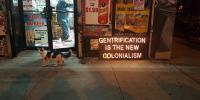
Since Christmas Eve, some lights along the streets and in the houses of Bushwick have spelled out a number of messages quite different from the festive wishes one usually finds during the holiday season. “GENTRIFICATION IS THE NEW COLONIALISM,” “NOT 4 SALE,” and “NO EVICTION ZONE,” some read.
Kenyan-based photographer Boniface Mwangi has captured his country's political and civic turmoil since the controversial presidential election in 2007. The violence and disorder he witnesses daily motivated him to take action, setting up a creative hub for activism called PAWA 254.
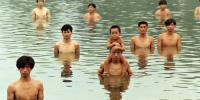
Zhuang Huan invited more than 40 men - laborers, fishermen, construction workers––who had recently migrated to Beijing from other areas of China to participate. Zhang Huan said, “In order to find these workers, I visited many of the shacks where they live.”
In the 1980s, Holzer and Lady Pink used New York as a backdrop for their artworks: Holzer wheatpasted posters and slogans on walls throughout Manhattan, and Lady Pink spray-painted graffiti on buildings and subway cars. The two also collaborated on a series of paintings on canvas, such as this work, for which Holzer composed phrases and Lady Pink did the painting.
An intervention created by the April 25 2015 Queer Crisis Collective organized by the Helix Queer Performance Network (HQPN), and part of an ongoing queer resistance project mentored by Avram Finkelstein. Over a period of 2 weekends, 8 artists met at the Hemispheric Institute of Performance & Politics to design a creative intervention during Pride month in NYC.
Hate hunting? Want to do something creative to protect wildlife and affect positive change? The Hunter's Poppet is a witch-craftivism intervention, free to use and share. A 'poppet' is a ritual object made to represent a human figure, charged with a specific intention. This set of instructions with images guides you in making your own poppet to place safely in an outdoor area.
Neighbors in modern cities have less and less communication, and they all go about their business as soon as they close the door. In Switzerland, a woman dies every week as a result of domestic violence, so in an effort to get everyone to act, the charity has put up an interactive billboard in a shopping mall that shows a man in a family doing violence to a woman.
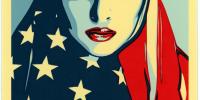
Colorful portrait of a Muslim woman wearing an American flag colored head scarf. Image on back of a woman with a rose in her hair in black and white with text that states, "We are resilient. We are indivisible. We are greater than fear. We will defend dignity. We will protect each other." -- "The We the People campaign aims to restore hope, imagination, curiosity, and creativity into our country’s dialogue.
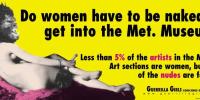
The Guerilla Girls are a group of feminist activist artists, who use facts, humor, and outrageous visuals to expose gender and ethnic bias and corruption in politics, art, film, and pop culture in their artworks. In 1989, they designed this billboard for the Public Art Fund (PAF) in New York, aimed to criticize the museum institutions for under-representing female artists and objectifying women.