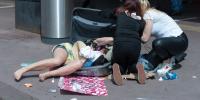
As massacres, civil wars, and violence permeated communities, people have searched for asylum in other countries. Due to its location and relative safety, Spain has become a common destination for immigrants seeking a better life. Female immigrants in particular tend to experience much more arduous journeys in that they frequently are subjugated to sexual abuse.
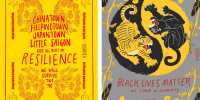
Unleashed by anxiety over the pandemic, the nationwide rise in anti-Asian hate has served as a call to action for many Asian American artists to take a stand: To actively challenge the historic negative stereotype of the vice- and disease-ridden Yellow Peril; to dismantle the pernicious and divisive myth of the model minority that pits achievements by Asian Americas as judgements against other communities of color; and to advocate for social justice, eq
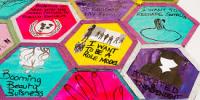
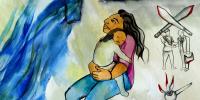
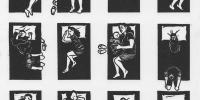
CultureStrike in partnership with Mariposas Sin Fronteras , End Family Detention and 15 artists from across the country, brings you Visions From The Inside, a visual art project inspired by letters penned by detained migrants.
Glowing softly in the West Texas desert night, artist Guadalupe Maravilla’s Mariposa Relámpago, was once an ordinary school bus but is now a richly decorated, mobile site for remembrance and healing. Like much of the artist’s work, this piece commemorates and confronts the artist’s journey to the United States as an unaccompanied, undocumented minor fleeing civil war in El Salvador in the 1980s.
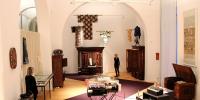
When Europeans of the 18th and 19th centuries established their grandest museums, each building meant to unite the world’s cultural heritage under a single roof, they had no doubt as to who should explain it all: themselves. They took a Eurocentric view, categorizing the spoils of colonial enterprise by nation and region, splitting art from craft, and nature from culture.
Visions from the Inside is a project enlisting 15 artists from across the country to create a piece of art based off letters from women in detention. The initiative, a collaboration between CultureStrike, Mariposas Sin Fronteras and End Family Detention, illuminates the horrific realities of life inside some for-profit detention facilities in the U.S., as well as the resilient spirit that keeps the inmates going.
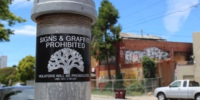
In this article, author Caroline Choi highlights different grafiti artists and their stories. These artists use their talent to tell their stories, ones that might not get to be told otherwise. She goes into the history of grafiti, and how it ties into how rich and white the art world has become.
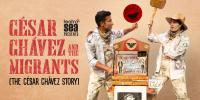
The play celebrates the life and legacy of the Mexican-American labor activist César Chávez. His early life as well as his partnership with Dolores Huerta, activism with the National Farm Workers Association, the 1968 grape boycott, and his ongoing commitment to nonviolent civil rights work.
In 2013, Ghana ThinkTank received a Creative Capital Award for Emerging Fields, enabling them to begin the multi-year ThinkTank at the Border project. In this project, they are collecting problems from civilian border patrols like the Minutemen, "Patriot" groups, and Nativist organizations, and bringing them to be solved by think tanks of undocumented workers in San Diego and recently deported immigrants in Tijuana.
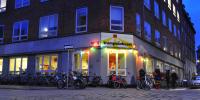
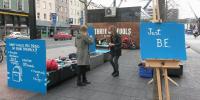
Trampoline House is a user-driven refugee justice community center located in the center of Copenhagen, where refugees, asylum seekers, and migrants can meet with Danish citizens and other residents of Denmark and share experiences, learn from one another, and work to create a more just and sustainable refugee and asylum policy.
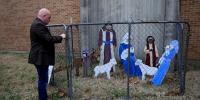
The nativity scene at Fellowship Congregational Church in Tulsa, Okla., looks a little different this year: There is a chain-link fence surrounding Mary, Joseph and the baby Jesus.
The display has been up since the beginning of December, but it drew news coverage this week after the church changed the message on its marquee to read, “The holy family was a migrant family,” and posted photos of the nativity on Facebook.
The artist has assembled a set of 300 installations around New York City, based around the concept of fences and borders, to showcase the ‘narrow-minded’ attempts used to ‘create some kind of hatred between people’
For FX Harsono, art is activism. Over the past four decades, performance, sculpture, and painting have become his means of nonviolent protest against government autocracy and ethnic strife in Indonesia.
The video for “Borders,” a song off MIA's album Matahdatah, features images recalling all sorts of migrations from the developing world—there are people crossing deserts, fences, and bodies of water. Though much of M.I.A.’s work has been about women and children, this video is filled with brown men: the ultimate bogeyman for many in the West, stereotyped as terrorists, criminals, and job-takers.
Nicoll Hernandez-Polanco, a Guatamalen transgender woman, came to the United States in October 2014 after surviving hate based harassment and violence in her home country. When she presented her case to the border patrol she was detained by Immigration and Customs Enforcement officers for past US deportations that occurred when she was an unaccompanied minor.
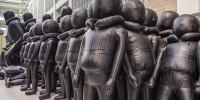
The exhibition Law of the Journey is Ai Weiwei’s multi-layered, epic statement on the human condition: an artist’s expression of empathy and moral concern in the face of continuous, uncontrolled destruction and carnage.
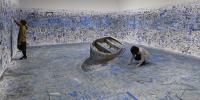
Add Colour (Refugee Boat) begins as an all-white boat in an all-white room. Ono’s instruction for this collective, participatory work reads: ‘Just blue like the ocean.’ You are invited to contribute your hopes and beliefs in blue and white.
During the economic crisis of 2008, bankers in Spain took advantage of the economically disadvantaged, and the artwork La Fiera en Sevilla, or the Wild Animal in Sevilla in English, brings attention to this money-centric act from the bankers. La Fiera refers to the bankers at the time that used predatory methods in their actions to forcibly evict poor people from their houses.
Republic of Moldova – “Before the war, Eva was a happy, carefree little girl, a first-grader full of joy who loved going to school, practicing taekwondo and drawing,” Olga recalls. Determined for her six-year-old daughter to have a joyful, stable childhood, Olga did all she could to help Eva thrive.
Mis(s)placed Women? (2009-2022), is a collaborative art project, consisting of performances, performance series, performance art workshops and delegated performances, including contributions by over 180 individuals from six continents. Many of them are artists, mainly identifying themselves as women from diverse backgrounds. Mis(s)placed Women?
The Amplification Project: Digital Archive for Forced Migration, Contemporary Art, and Action (https://theamplificationproject.org) is a crowdsourced community digital archive aiming to raise the visibility of art and cultural productions inspired, influenced, or affected by forced migration and refugeehood.
Shackles. Cotton. The Big House.
Americans tend to think of slavery in terms of chattel slavery. Plantation Slavery. Slavery where human beings are bought, sold, and owned. The kind outlawed in the United States by the Emancipation Proclamation in 1863.
Slavery as a relic of the 19th Century.
“Six of us lived, worked, slept in a 10-by-10 (foot) room without a bed, bathroom, or clean water,” Nasreen Sheikh remembers.