Jews For Palestinian Right of Return
January 1, 2013
“For Palestinians, the right to return home and the right to live in dignity and equality in their own land are not any less important than the right to live free of military occupation.”
–Prof. Saree Makdisi[1]
For more than a century, Zionists have sought to construct a “Jewish state” through forced removal of the indigenous Palestinian people.
IMAPCT are youth activists who view the creative arts and leadership training as a way to develop ourselves and change the world in a positive way. They believe that they must be the message that bring through hardwork, focus, discipline, unity and the principles of S.O.S. safe space, outstanding effort and service to their family friends and community.
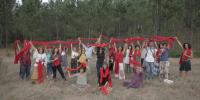
Linha Vermelha was created in 2016 by the non-profit organization Academia Cidadã (Citizenship Academy). At that time there were fifteen active contracts for oil and gas drilling and we were inspired by the “Red Line Action” in Paris, during COP21 and decided to create this campaign.
Native American groups are expected to protest the Kansas City Chiefs on Sunday, calling for the AFC champions to drop their name and logo as they take on the Philadelphia Eagles in Super Bowl 57.
The Chiefs wear the arrowhead logo on their helmet and use a large drum to kick of their home games, as fans routinely engage in what’s known as the “tomahawk chop” chant, all of which critics say draw on offensive and racist stereotypes.
NOT READY TO MAKE NICE: GUERRILLA GIRLS BIRTHDAY
30 YEARS AND STILL COUNTING!
BLOWOUT PARTY WITH DJ AND CAKE!
Friday, May 15 8-10 PM • ABRONS ARTS CENTER 466 GRAND ST, NY
ALSO AT ABRONS ARTS CENTER 466 GRAND ST, NY
• May 1-17, 2015: Pop Up Exhibition of GG work 1985-2015
• May 17: Exhibition walkthroughs 3pm
The Publixtheatre Caravan is the English name for a travelling project of the Volxtheater Favoriten, a Vienna-based international theatrical troupe that has been creating site-specific theatrical interventions in public space as well as stage-based performances since 1994. It is a political and artistic project that is part of the No Border Network and the Platform for a World Without Racism.
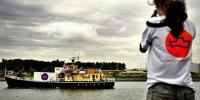
Women on Waves sails a ship to countries where abortion is illegal. With the use of a ship, early medical abortions (till 61/2 weeks of pregnancy) can be provided safely, professionally and legally.
Covenant House has started a ‘Sleep Out’ movement that shines light on the youth homelessness crisis and raises funds for young people who seek shelter. "Covenant House empowers young people to overcome homelessness and trafficking by providing them with safe housing, food and clothing, and relentless support. Sleep Out events are held for people who want to join the movement as they give up their bed for one night in NYC.
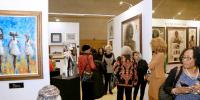
The International Harlem Fine Arts Show (HFAS) is the largest traveling African Diasporic art show in the United States. Inspired by the Harlem Renaissance, HFAS provides a platform for African Diasporic visionaries and American visual artists to exhibit and sell their artwork. The show also aims to create economic empowerment, educational opportunities and professional recognition within the multicultural community.
Tamms Year Ten is an all-volunteer grassroots coalition of artists, prisoners, men formerly incarcerated in Tamms, family members and other people of conscience. In 2008, at the ten-year anniversary of the opening of the Tamms supermax prison, the group launched a legislative campaign to call for its reform or closure. Men were originally supposed to be there for one year—but at that point 1/3 of them had been in solitary confinement the entire decade.
Street Art Projects brings talented visual artists to public events, community groups, and schools, to offer a window into the creative process. Our workshops and projects combine chalk art with story telling, encouraging a deeper understanding between different cultures through the creation of collaborative public artworks. The work is not just about public art, its about making a public places as a focal point for education.
Young Japan: For too long, Japan's youth have been a silent minority. Now, on the eve of a crucially important general election, they seek a bigger voice in forging the future of their aging nation
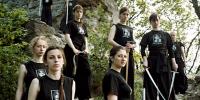
In the Ukraine, a country where females are victims of sexual trafficking and gender oppression, a new tribe of empowered women is emerging. Calling themselves the “Asgarda”, the women seek complete autonomy from men. Residing in the Carpathian Mountains, the tribe is comprised of 150 women of varying ages, primarily students, led by 30 year-old Katerina Tarnouska.
Despite the pushes to motivate more young girls into STEM (science, technology, engineering, and math) fields, women are still very underrepresented in almost every scientific field. Part of this motivation is because a lot of young girls would rather do something else.
Time as currency is an interesting economic model related to artistic practice.
According to the creators of Time/Bank, Julieta Aranda and Anton Vidokle, the project "is a tool by which people or a group of people can create an alternative economic model where they exchange their time and skills, rather than acquire goods and services through the use of money or any other state-backed value."
For the past five years, we’ve screened SIMA juried films in communities and classrooms across six continents and witnessed an increasing demand to use the inspirational force of documentary filmmaking to build a global digital community around today’s most pressing issues.
Four prominent Australian artists – Aretha Brown, Claire Martin, Kaff-eine and Jane Gillings – will gather in Canberra this Sunday, to discuss their art, activism and ideas, marking the closing weekend of Kambri’s HERE I AM festival.
The Art Activism by Great Women Conference is a day-long event, involving artist talks, Q&A sessions, panel discussions, afternoon tea, wine tasting and networking.
In Portland, Ore., organizers of the “Reparations Happy Hour” invited black, brown and indigenous people to a bar and handed them $10 bills as they arrived, a small but symbolic gift mostly funded by white people who were asked not to attend.
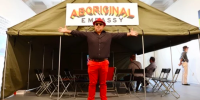
Richard Bell has often called himself ‘an activist masquerading as an artist’. Aboriginal journalist and radio broadcaster Daniel Browning has suggested that Bell is also ‘a megaphone.
True Connection is a non-profit organization based in Los Angeles, driven by young female visionaries who set out to reach new horizons in healing, empowerment, education, and community building. We are pioneering a truly innovative “Healing Arts Program,” which integrates trauma education, expressive arts therapy, and natural healing techniques and modalities to help children recover, learn and grow from their traumatic life experiences.
On May 14, 2022, the Buffalo community suffered a devastating act of violence when a gunman opened fire at the Tops Friendly Market on Jefferson Avenue, killing ten people and wounding three. Many have asked how to help.
In partnership with Tops, the National Compassion Fund has established the Buffalo 5/14 Survivors Fund to provide direct financial assistance to the survivors of the deceased and those directly affected by this tragedy.