change
region
medium
issue
Anton
In 2007, Andrew Danziger had an architecture class assignment at the University of Texas at Austin to propose an urban intervention in Austin. The goal was to think about public art in unexpected ways. One classmate dreamed up a blank traffic sign; another suggested putting a bench at a bus stop that lacked one. Danziger hit on the idea of installing swings in surprising places, and then he went beyond the assignment by actually doing it.
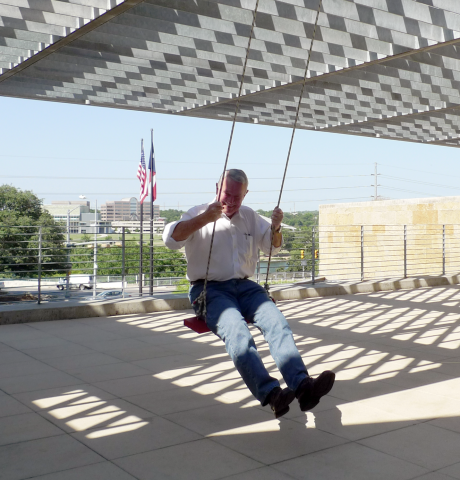
One of the first swings Danziger and his friends hung was on Guadalupe near the School of Architecture. Within hours, an Austin police officer took it down. “But before he did,” Danziger says with a hint of pride, “he swung on it.”
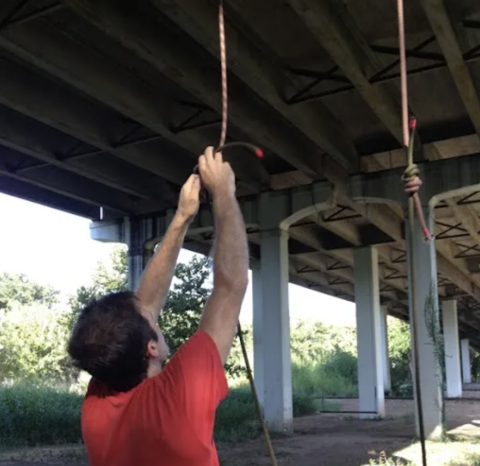
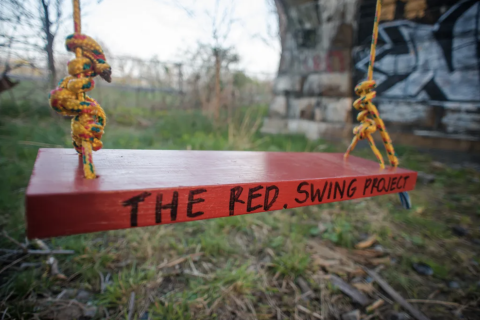
Initially, Danziger hung all the swings himself, chronicling their locations online. Then he posted a YouTube video showing anyone willing to spend the time and money ($2) how to make and hang their own red swing. Since the project first began, the concept has taken off with other people building their own red swings to place. Instructions for hanging red swings are provided by the Red Swing Project’s website.
He stayed anonymous for years. “I wanted to play with the idea of authorship,” he says. “I didn’t want it to be about me. Now I’m hardly hanging any swings, and the project has taken on a life of its own.”
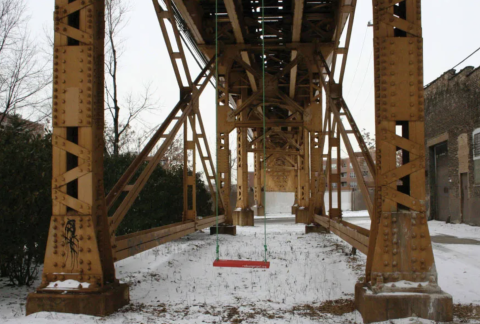
Attempting to use under-utilized public spaces, the red swings have been hung in unexpected places having a “familiar object set in an unfamiliar place.” They have been found in vacant lots, on downtown streets, and over small creeks. The response often prompts the playfulness the creator desired, but the swings are also found cut down in some locations.
In 2008 he expanded the project internationally, hanging swings first in India and, the following year, in France, Spain, and Portugal. By 2013, more than 250 Red Swings had appeared across the globe, from Thailand to Brazil, Haiti to Australia, Poland to Taiwan. Some cities saw the swings as vandalism, while others embraced them. “In Washington Square Park in New York, a swing was taken down within 15 minutes,” Danziger says, “but in Udaipur, India, a shopkeeper closed down his shop to go hang a swing in a temple.”
As the project has grown from its roots at the University, it’s gained international recognition. Red swings have been featured in art and design exhibits in Venice and New York. Texans have embraced the hometown project, too: in 2012, Art Alliance Austin commissioned the Red Swing Project to hang swings downtown.
But official accolades are merely one indicator of the Red Swing Project’s success. By hanging swings in the most unexpected places, Danziger and his collaborators effectively transform some of the grimmest locales into veritable public parks.