Oh, to be a crow.
Maligned as scavengers that torment their dead brethren. Portrayed as aerial killers in the 1963 Alfred Hitchcock classic, “The Birds.”
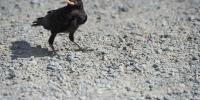
In France, though, the wily crow is getting a makeover. Puy du Fou, a historical theme park in the Loire region about four hours from Paris, has trained six crows to pick up cigarette butts and bits of trash and dump them in a box.
Mon Dieu! Are the pigeons of Paris next?
We Animals is an ambitious project which documents, through photography, animals in the human environment. Humans are as much animal as the sentient beings we use for food, clothing, research, experimentation, work, entertainment, slavery and companionship. With this as its premise, We Animals aims to break down the barriers that humans have built which allow us to treat nonhuman animals as objects and not as beings with moral significance.
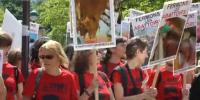
Anti-Fur advocates have been protesting through demonstrations for decades, throwing red paint on women wearing fur coats, passing out leaflets and sporting the slogan “Fur Is Dead” on t-shirts and stickers and spray-painting it on buildings in cities throughout the globe.
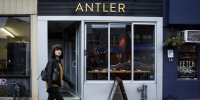
After weeks of vegan activists protesting in front of his nose-to-tail bistro, chef Michael Hunter decided to make a statement by butchering a freshly-killed deer’s leg in the window of his Toronto restaurant, Antler Kitchen & Bar, right in front of the demonstrators. “I figured, I’ll show them,” Hunter tells writer Corey Mintz. “I’m going to have my own protest.”
At ‘Arcadia Earth,’ Dazzle Illuminates Danger
Using augmented reality, virtual reality and installations of light and art, the creators of this pop-up exhibition hope to inspire action on climate change.
By Laurel Graeber
Oct. 23, 2019
The creators of “Arcadia Earth” want to awaken your conscience. But they also plan to make that guilt trip extraordinarily fun.
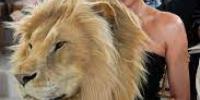
PARIS — Ten a.m. on a frigid Monday morning, the first day of the couture shows, and Kylie Jenner was strutting through the marble halls of the Petit Palais trying to find her seat for Schiaparelli, shoehorned into spiky stilettos and a black velvet one-arm gown, a full-size tawny lion’s head jutting from the side. It was as if Aslan had taken a break from Narnia and stuck his muzzle through a time-space continuum under her armpit.
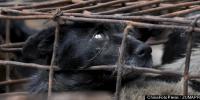
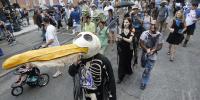
Thousands of animal rights activists marched against a draft law on Sunday that would make changes to Turkey's Animal Protection Law No. 5199, seeking to introduce practices currently used in other countries such as collecting stray animals from the streets and euthanizing members of the “excess” population.
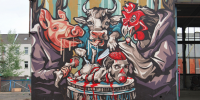
Creative Graffiti at the Urban Culture Festival in Germany
By Loredana Loy
A street art project by by KD Key Detail from Minsk, Belarus--created and featured at the IBUg 2013 Urban Culture Festival in Zwickau, Germany.
The project is entitled "Bon Appetit." Images speak louder than words. Links and photos below.
Cruelty-Cutter is cruelty-free shopping made simple! Cast away any doubts when purchasing items by using Cruelty-Cutter to scan an item and have an immediate response about its animal testing status. Share your results with friends on social media and also share your concern or praise with the company itself. Companies that still choose to test on animals will get the message that Cruelty-Cutter users are against what they are doing!
On October 2nd, three animal rights activists shocked the world with an extraordinarily bold act, organized by Alex Bojour. They all were branded alive (http://www.youtube.com/watch?v=RA4q1pU957c) as a symbolic act of identification with the animals that are branded and used by the human species, conveying the message of animal equality.
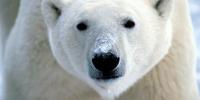
With Radiohead's "Everything In Its Right Place" as the soundscape, Jude Law narrates in this powerfully sad little video clip created in collaboration with Greenpeace. Please visit savethearctic.org
and sign the petition.
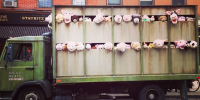
Sirens of the Lambs
By Banksy
A slaughterhouse delivery truck touring the meatpacking district and then citywide for the next two weeks.
http://www.banksyny.com/#
Video here:
http://www.youtube.com/watch?v=WDIz7mEJOeA
I must first come clean, I studied fine arts in high school from years nine to 12. Since my studies were concluded, I had never held a paintbrush again.
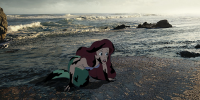
Jeff is an animation storyboard artist from Los Angeles, previously working as an animation artist on several famous Disney movies. He uses his talent to produce work highlighting environmental and social issues worldwide with Disney characters, called Unhappily Ever After. His work includes images of Elsa from Frozen on melting ice caps and Alice from Alice & Wonderland taking drugs down a dark alley.
In May 2010, as oil from the Deepwater Horizon disaster continued to spread in the Gulf of Mexico, growing outrage from residents in New Orleans at the response by government agents and corporate executives, opened up new horizons of political possibility.
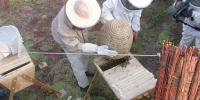
The survival of bees in the world is threatened and the extinction of bees is a serious threat to the human race too. Over the past few years, it seems that bees have a greater chance of survival in cities than in rural areas where they are heavily threatened by pesticides used in agriculture. For this reason, this project aims to create a safety area, as a sort of haven for all species of bees on a roof in Staatsliedenbuurt in Amsterdam.
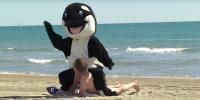
What would it be like if we switched positions with whales in captivity?
Nothing like this – but at least prankster Rémi Gaillard had some fun trying to recreate the scenario.
Showcasing death to defend life
El Pais, Madrid
Activists protested with the organization Animal Equality (Igualdad Animal) in Puerta del Sol, Madrid, Burgos, and Toledo on December 10, commemorating the international Animal Rights Day.
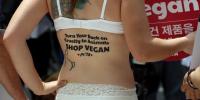
An animal rights activist sporting only a white bikini, bunny ears and tail has been spotted protesting against fur in Pyeongchang, South Korea, which is hosting the Winter Olympics 2018.
Ashley Fruno discussed the People for the Ethical Treatment of Animals' (Peta) stance on fur in front of the Olympic rings at the Alpensia Resort.
This is one of the noblest urban interventions I've seen lately. Two girls who go to a subway station in Santiago, Chile with lots of colorful balloons with helium. In the balloons write messages like "touch me", "hold me", "adopt me", "love me" or "feed me".
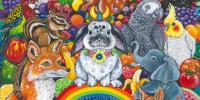
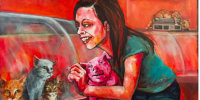
Another incredible artist determined to change the world for animals is Dana Ellyn. This DC-based artist started being a full-time painter in 2002 after leaving a corporate job. Her paintings do not shy away from showing the exploitation of animals, as well as critiquing society in general. Her paintings are meant to start a conversation, and they are certainly doing that as effective advocacy for animals.