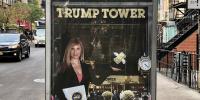
NEW YORK, Ny., Nov 19, 2018 - Two artists, Actress/Creator/Native New Yorker Maia Lorian and collaborator veteran NYC Street Artist Abe Lincoln Jr. bring to you “A Presidential Parody.” In a nation that seems to place higher value on the American dollar over the American life, the artists felt it was time to release an ad campaign that reflects Trump’s “all American” values.
In an endeavor to raise awareness at the local and international level, Razia organized the Mifohaza Masoala (Wake Up Masoala) music and environmental festival, which took place at the edge of the Masoala Rainforest in October 2011. The concert featured some of Madagascar’s most thrilling performers, and the festival was a tremendous success, with over 10,000 people in attendance.
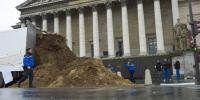
"Energy costs surged with the Feb. 2022 launch by Russia of full-scale war in Ukraine and hit hard for farmers reliant on tractors, harvesters and other fuel-guzzling equipment. Prices also soared for other inputs that underpin intensive farming, notably fertilizers. French farmers were already struggling to compete in the increasingly globalized economy.
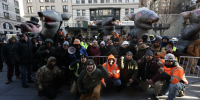
A fat cat, a pig wearing a top hat and five rats. All seven inflatables faced the 34th Street entrance of the Empire State Building last Thursday, two weeks into a protest by members of Laborers Local 79 who rallied, hundreds strong, in the afternoon shadow of the props.
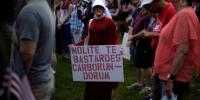
In state capitals and street protests, women’s rights activists have been wearing red robes and white bonnets based on “The Handmaid's Tale,” the 1985 novel that is now a series on Hulu.
Silent, heads bowed, the activists in crimson robes and white bonnets have been appearing at demonstrations against gender discrimination and the infringement of reproductive and civil rights.
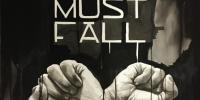
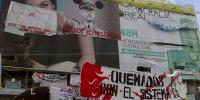
Daniel Hewson describes the use of protest posters and the work of collective, Burning Museum, and artist, Faith47, in the Fees Must Fall movement taking place in South Africa:
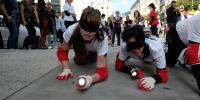
Conquest is a compelling new collective performance conceived by acclaimed artist Pope.L (b. Newark, 1955). It is inspired by his iconic solo crawls, where the artist dragged himself across a number of different urban landscapes. Navigating the streets and parks of Downtown Manhattan, Conquest extends this irreverent and provocative forty-year tradition of public performance with an ambitious group crawl involving over 140 volunteers.
Just over a decade ago on May 15, 2011, a wave of social outrage began as the Spanish people collectively decided that they had had enough of the corruption, cuts, and inequalities affecting their country.
Cosmic Generator presents a network of characters working in nonsensical, and at times absurd, economies. Artist Mika Rottenberg uses footage from actual discount dollar stores in Calexico, CA; Mexicali, Mexico; and Yiwu, China to recreate the imaginary “life” of a product, from its production in the factory to the moment it is sold.
Visions from the Inside is a project enlisting 15 artists from across the country to create a piece of art based off letters from women in detention. The initiative, a collaboration between CultureStrike, Mariposas Sin Fronteras and End Family Detention, illuminates the horrific realities of life inside some for-profit detention facilities in the U.S., as well as the resilient spirit that keeps the inmates going.
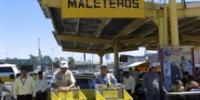
Malteros are the porters who transport luggage and goods between the border of the US and Mexico. Working with a group of maleteros in 2005, artist Mark Bradford collaborated on a system of maps and signs that placed the marginalized work of the unofficial maleteros alongside that of the sanctioned labor of policemen and taxi drivers.
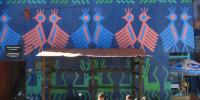
Nestled on the banks of Lake Atitlán in Guatemala, Santa Catarina Palopó is a small town brimming with vibrant colors and stunning natural views. Despite its natural beauty and cultural heritage, the community struggled with economic development and poverty for years until they had the opportunity to harness the power of art and transform the town.
Apple implemented improved reservation procedures and policies for employees dealing with the iPhone 6 launch at retail stores on September 19th, 2014, but the launch at the company’s Hong Kong store hadn't gone quite as smooth as elsewhere. The store was hit by protesters from the Students and Scholars Against Corporate Misbehavior (SACOM) and also required police to help disperse customers that had waited in line without reservations.
Zhuang Huan invited more than 40 men - laborers, fishermen, construction workers––who had recently migrated to Beijing from other areas of China to participate. Zhang Huan said, “In order to find these workers, I visited many of the shacks where they live.”
Cheril Linett is a female artist from Chile, with a background in performance art and stage performance, who primarily focuses her artwork on feminist issues in Chile, especially ones involving violence, murder, hate crime and different kinds of oppression and assault, but also creates artwork reflecting issues in other parts of Latin America.
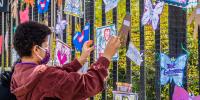
In May 2020, a team of artists, activists, folklorists, and people who lost loved ones to Covid-19 came together to make monthly memorial sites in New York City to remember victims of the Covid-19 pandemic. They continued installing memorials around New York City every month during the summer of 2020.
Cheril Linett is a female artist from Chile, with a background in performance art and stage performance, who primarily focuses her artwork on feminist issues in Chile, especially ones involving violence, murder, hate crime and different kinds of oppression and assault, but also creates artwork reflecting issues in other parts of Latin America.
The True Cost is a 2015 documentary film directed by Andrew Morgan that focuses on fast fashion. It discusses several aspects of the garment industry from production—mainly exploring the life of low-wage workers in developing countries—to its after-effects such as river and soil pollution, pesticide contamination, disease and death.
From Public Delivery:
"The art piece, which was showcased at the Flashpoint Gallery in Washington D.C. from February 1 to 17, 2019, allowed visitors to interact with it. The audience had a pile of crumbs placed right in front of the three-walled setup, which they would through and watch as ‘Ivanka’ vacuumed them all up.
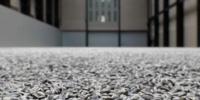
Ai Weiwei's installation Sunflower Seeds is a profound commentary on both historical and contemporary issues through the medium of art. First exhibited at Tate Modern in London from October 12, 2010, to May 2, 2011, the work features an astonishing one hundred million handcrafted porcelain sunflower seeds, spread across the gallery's 1,000 square meter Turbine Hall to a depth of ten centimeters.
This is the sixth piece of the series Tatlin’s Whisper which examines the relationship between apathy and anaesthetization of the images in the mass media. This series intends to activate images, well-known because of having been repeatedly seen in the press, but are here decontextualized from the original event that gave way to the news and staged as realistically as possible in an art institution.
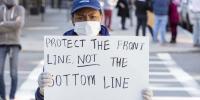
Working in a grocery store has earned me and my co-workers a temporary status. After years of being overlooked, we suddenly feel a sense of responsibility, solidarity, and pride. On a private Facebook group page for my company, Trader Joe’s, one employee from Washington State posted a picture of a company-issued work shirt hanging from the ceiling of the store. A sign attached to the shirt read not all heroes wear scrubs.
Work ideology centers around sustainable work. Through fifteen interviews, workers and prospective workers were interviewed about their experiences with work and the job search. Those interviews are analyzed and compiled on work ideology. However, work ideology goes further than showcasing the interview results, it allows for anonymous responses to be entered as well, expanding the research’s accessibility to every worker.
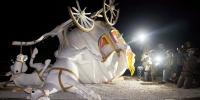
“He describes it as a “family theme park unsuitable for small children” – and with the Grim Reaper whooping it up on the dodgems and Cinderella horribly mangled in a pumpkin carriage crash, it is easy to see why.
Banksy’s new show, Dismaland, which opened on Thursday on the Weston-super-Mare seafront, is sometimes hilarious, sometimes eye-opening and occasionally breathtakingly shocking.
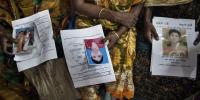
On April 24, 2013, more than 1,000 lives were taken in the Rana Plaza Collapse. While history remembers this tragic event as the deadliest garment factory accident, activist and photographer Taslima Akhter reveals a story of dreams crushed by structural murder. Dedicating her career to the lives and struggles of garment workers in Bangladesh, she has continued to foster a community rallying together for safer working conditions.