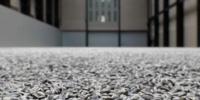
Ai Weiwei's installation Sunflower Seeds is a profound commentary on both historical and contemporary issues through the medium of art. First exhibited at Tate Modern in London from October 12, 2010, to May 2, 2011, the work features an astonishing one hundred million handcrafted porcelain sunflower seeds, spread across the gallery's 1,000 square meter Turbine Hall to a depth of ten centimeters.
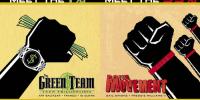
Following in the strong tradition of using graphic novels to explore social ills, DC Comics is releasing two new politically activist issues in their "New 52" series.
The first is called "The Movement" and is written by Gail Simone. Simone describes that "The Movement is an idea I’ve had for some time. It’s a book about power–who owns it, who uses it, who suffers from its abuse."
In March 1939, a 23-year-old Billie Holiday walked up to the mic at West 4th's Cafe Society in New York City to sing her final song of the night. Per her request, the waiters stopped serving and the room went completely black, save for a spotlight on her face.
This country belongs to whoever shows up. And do you know who shows up for every election? Old people. But only 46% of people18-34 years old voted in the last election.
So the elderly have a disproportionate influence on our politics and our country. And a lot of them would like to keep it that way.
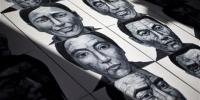
Beijing-based artist Liu Yi is working on a series of black-and-white portraits he knows will never be shown in a Chinese gallery. His varied subjects — men and women, young and old, smiling and pensive — have one thing in common: They are Tibetans who have set themselves on fire to protest repressive Chinese rule.
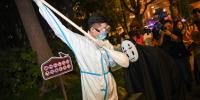
Several nights of Halloween celebration in Shanghai provided a vivid, if indirect, commentary this week on the malaise gripping the world’s second-largest economy.
In 2010, the College Republicans used tens of thousands of dollars from student fees to bring Ann Coulter to speak at the University of Wisconsin-Milwaukee.
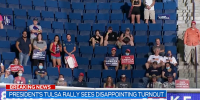
Users on the social media app TikTok are claiming some credit for the disappointing turnout at the president's rally in Tulsa, Oklahoma, over the weekend, after a weeks-long campaign to artificially inflate the number of people registered to attend. The prank may have helped lead the Trump campaign to boast about more than a million people seeking tickets for the rally — while only about 6,200 ended up filling seats.
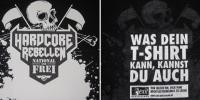
An anti-Nazi organization called Exit-Deutschland targeted a right-wing Rock Festival in a city called Gera. They got in contact to the festival organizers by using a fictitious name, and they distributed 250 trojan t-shirts with a writing “Hardcore Rebels” during the festival. When the recipients of the shirts went back home and washed them.
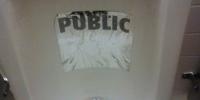
Two reflective stickers in a bathroom stall. When you sit down you can see your face in the bottom one. When you stand you can see your face in the top one, your groin in the bottom one. The top one says "Public", the bottom one says "Private". Or maybe the top one says "Private", and the bottom one says "Public". Which one is correct?
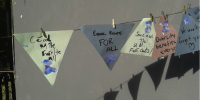
Topic: Displaced people
Concept: Explore and communicate some of the issues around displacement in a global, European and Irish context.
Date of action: 11th March 2.30 to 4.20 pm
Place: Emmett Place, Cork City, Ireland
If there’s one thing we know for certain about China in 2019, it’s that people there love their apps. They use WeChat to talk with friends; they spend hours battling virtual enemies on PUBG; they binge-watch short videos on Douyin. And so why shouldn’t the Communist Party get in on the action?
In keeping with his activist turn on 2016’s 4 Your Eyez Only, J. Cole’s new album, KOD, is an exploration of addiction. The title has three different meanings that all speak to this aim: Kids On Drugs, King OverDosed, and Kill Our Demons. Each feeds into the next in this narcotic odyssey.
The environment is one political topic that has become more significant in countries all around the world. One current example of this can be seen in Madrid with the Madrid Central program, introduced in an effort to lower carbon emissions in the city. With the new right winged candidate expected to be elected as the new president of the region, he plans to get rid of the program entirely.
The Colors Mountain is a collective intervention project that uses a virtual space dedicated to the observation and investigation of alleged ecological crimes , with the goal of using the concept of "reasonable doubt", not only for possible court acquittal but also cause a formal investigation that could lead to a court complaint.
Visions from the Inside is a project enlisting 15 artists from across the country to create a piece of art based off letters from women in detention. The initiative, a collaboration between CultureStrike, Mariposas Sin Fronteras and End Family Detention, illuminates the horrific realities of life inside some for-profit detention facilities in the U.S., as well as the resilient spirit that keeps the inmates going.
The Hong Kong political crisis is now playing out in the virtual world.
Popular online video game "Grand Theft Auto V" has become a battleground between protesters in the semi-autonomous Chinese city and their rival players in mainland China.
A juried exhibition of fiber art created by the Artist Circle Alliance to protest the Trump administration’s actions and policies.
This is a traveling exhibition to 13 venues across the U.S. All work in the exhibition, as well as the nearly 560 pieces submitted for jurying, are shown on our website.
Directed by Fernando Sariñana, Todo el poder centers around the politics and corruption that shroud the Mexican police system. Featuring Demián Bichir as Gabriel, a filmmaker whose career has left him assaulted and robbed in broad daylight more times than he cares to remember, the film itself was inspired by Sariñana's personal experience with urban crime oftentimes perpetrated by the police themselves. ~ Tracie Cooper, Rovi
The campaign bus was attracting funny looks. On its side was the by now all-too-familiar last name of the Republican presidential frontrunner. Somewhere inside the castle-shaped hotel next door, Donald Trump was holding court, as hundreds awaited another rally of bombast and branding.
Established Cape Town based artist Brett Murray returns to Goodman Gallery Johannesburg with Hail to the Thief II. This body of satirical work continues his acerbic attacks on abuses of power, corruption and political dumbness seen in his 2010 Cape Town show Hail to the Thief.
A new exhibition titled “Afrofuturism: A History of Black Futures” will debut at the National Museum of African American History and Culture (NMAAHC) to examine Afrofuturist expression and culture as it relates to music, activism, art, and more.
Khalil Bandib is a Berkeley-based, award-winning editorial cartoonist with a unique perspective. He critiques a myriad of topics, from racism and homophobia to foreign policy and the Patriot Act. Bandib was born in North Africa under a French colonist regime; he brings a non-Eurocentric perspective not typically visible in large corporate media.