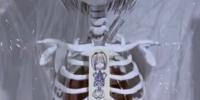
A unique piece captured significant attention at the Central Academy of Fine Arts undergraduate graduation exhibition in June. The work featured an "anime-style" girl's skull linked to a human skeleton and internal organs, all encased within a thin film. As visitors entered the exhibit area, her breathing and gaze would alter accordingly.
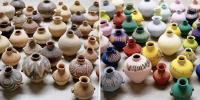
Exhibition visitors have expressed feelings of uneasiness or even pain and nostalgia when seeing Colored Vases by Ai Weiwei1. The 51 vases that make up the artwork are originally treasures from the Neolithic Age (5000–3000 BCE) and the artist has dunked them in common industrial paint.
Why did Ai Weiwei do it?
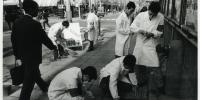
On October 16, 1964, the artist collective Hi Red Center, clad in sanitation masks and white uniforms and wielding small brooms and toothbrushes, spent several hours meticulously cleaning the streets of the Tokyo district of Ginza, amid the hustle and bustle of a “normal” day.
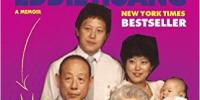
Fresh off the Boat examines the immigrant struggle told from the perspective of Eddie Huang, a modern day chef and video entrepreneur who has found a way to use food to explore culture, diaspora, and more through food, television, and the book that I am discussing now.
This book serves as an important storytelling experience of the immigrant and helps bridge the generational struggles often seen in these stories.
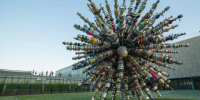
For one artist, the ugly and the beautiful are equivalent concepts. In 2018, designer and artist Choi Jeong Hwa featured an exhibition titled 'Alchemy' at The Artling where he uses recycled and non-biodegradable materials in his work that he has been collecting for 30 years, such as household trash, glass, and steel. 'Dandelion' is one of his masterpieces installed in the outdoors in Seoul, South Korea.
South Korean artist Do Ho Suh is internationally known for his ghostly, diaphanous architecture and fabric-made objects, which create imaginary spaces that are physically present yet impossible to inhabit. His large-scale, immersive, but impermanent installations serve as “acts of memorialization,” exploring themes of identity, home, and the tension between personal and public space.
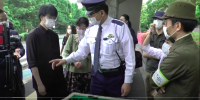
Kurokawa Cup is a protest against former head Tokyo prosecutor Hiromu Kurokawa's de facto immunity after he had played mahjong for money, which is an illegal act in Japan.
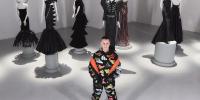
Two pairs of dusty, pastel-orange roller skates. A ram's skull. Several meters of tangled, bright red rope. They aren't the sort of items you'd find in the great fashion houses of Europe or on North American catwalks.
But, for unconventional Chinese designer and performance artist Wan Yunfeng, they are perfect.
From his small apartment in eastern Beijing, Wan makes fashion that only he wears.
Singaporean artist Lee Wen’s series Journey of a Yellow Man (1992–2012), one of his most famous and long-standing performances, was not simply a personal affront, it was a political affront. At the intersection of Asian art history, critical race theory, and migration and diasporic studies, one is never far (enough away) from the chromatic framing of race and ethnicity: yellow race, yellow peril, yellow face, the forever foreigner.
This is a series of paintings reflecting the struggle and sacrifices made by the Tibetan people for independence. The author is Tenzing Rigdol, who is a Tibetan and influenced a lot by the Dalai Lama and traditional Tibetan culture. The paintings are full of Tibetan cultural elements. For instance, the characters created in the paintings are Tibetan monks, who are the typical representatives of their culture.
'Jealousy Ms. Vy' is a creative project of the Institute of Occupational and Environmental Health, in collaboration with musician Khac Hung, singer Min and singer Erik.
Through this project, we look forward to empowering and trusting the community, so that we can join hands to combat COVID-19 (aka nCoV-2019).
Jeremy Scott and Moschino may no longer be a thing but the designer is still plenty busy. Case in point, Scott's new partnership with Korean car manufacturer Hyundai, the latest in the latter's ongoing Re:Style upcycling program.
For Hyundai Re:Style 2023, Jeremy Scott has saved discarded Hyundai Motor Car parts from the junk pile, instead transforming them into wearable couture (car-ture?).
Grangeon's long-running traveling exhibit, Pandas on Tour, features 1600 papier-mâché pandas. That's approximately one for as many as there are left in the world (recent estimates actually place the number slightly below that, at 1596).
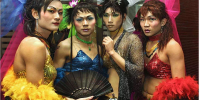
The documentary film "The Two Lives of Li Ermao" recorded the bumpy life experience of a transgender Li Ermao and her unique and moving story.
"Others only live one life, I live two." Looking back, the "two lives" are not only the emotional disillusionment and the swing of identity that Li Ermao has experienced in the past 17 years, but also her helpless but accurate summary of her life.
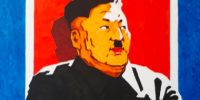
Song Byeok is one of the most acclaimed Korean artists living today. He is from North Korea, where he was a propaganda artist for the North Korean government for two decades. After defecting in 2002, Byeok has turned his prolific creativity into powerful, satirical art using North Korea’s ruling culture as motifs.
Yu Hong’s Female Writer, a painted and photographic portrait of the writer Zhao Bo 趙波 (b. 1971), recalls courtly images of idealized beauties. Yu, however, deliberately complicates the perspective in her composition: she asked the sitters for her She series to select photographs of themselves that could be paired with her paintings, meaning that the images together convey dual female perspectives, both the artist’s and the subject’s.
Shu Yong is an artist who has been passionate about environmental protection in recent years. "The Earth Is Bleeding" was created in 1998. The creation was carried out in a studio of more than ten square meters.
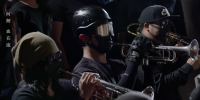
Art of the Umbrella movement refers to artistic works created as part of the Umbrella Movement in Hong Kong which demanded democracy in the election of the territory's top leader. Most of the physical works of art are located within the three main protest sites of Admiralty, Causeway Bay and Mong Kok.
As the summer warms up, bringing with it sleeveless tops, Xiao Meili, a women’s rights advocate, is collecting photos of women’s armpits. Her goal: to challenge a growing belief in China that a woman must have hair-free armpits to be attractive.
Direct Cause: Students' freedom to enter and leave the campus has been restricted for two weeks, but the university has not even issued an official document, only a verbal rule of "not leaving the campus unless necessary."
Objective: To protest the arbitrary closure policy of Beijing Film Academy.
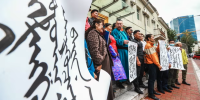
Thousands of ethnic Mongolians have protested across northern China in opposition to Beijing plans to replace the Mongolian language with Chinese in some school subjects.
Many girls in China may have seen the advertisements of egg donation as a surrogate, in hospitals, schools, public toilets, shared bikes, ATMs...... They are everywhere and the number of this kind of advertisements is large. Though there are lots of girls who have never seen such advertisements or would never believe in them, there would still be some girls who would dial the numbers on the advertisements.
Zuoxiao Zuzhou is a Chinese singer whose accented, croaky voice is hardly ever in tune. But for his fans he's the voice of a generation — one of the very few voices who dare to speak out. After a collaboration, Cowboy Junkies member Michael Timmins called him "China's Leonard Cohen."