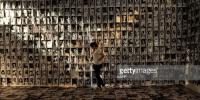
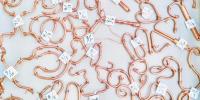
According to the World Health Organization, China is home to two-thirds of the world's women who wear IUD devices. This is a form of contraception that was developed after World War II, and in essence, comes from discrimination against women. In 2014, artist Zhou Wenjing made a work of IEDs, which was recently exhibited in Beijing.
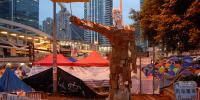
The pro-democracy protests in Hong Kong have a new mascot: a roughly 12-foot-high figure of wood blocks holding a bright yellow umbrella in its outstretched right hand. The students call it Umbrella Man.
Umbrellas emerged as a symbol of the demonstrations after dozens of students wielded them on the night of Sept. 28 to fend off pepper spray as they jostled with the police.
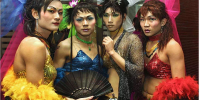
The documentary film "The Two Lives of Li Ermao" recorded the bumpy life experience of a transgender Li Ermao and her unique and moving story.
"Others only live one life, I live two." Looking back, the "two lives" are not only the emotional disillusionment and the swing of identity that Li Ermao has experienced in the past 17 years, but also her helpless but accurate summary of her life.
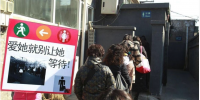
A street photography exhibition located in Beijing’s most crowded tourist attractions, Dongsi Hutong, to get a voice the Chinese government’s censorship of art works in public space. To hedge the city’s regulation , the human body photography were displayed in the street stores of Dongsi Hutong.
In time for the 30th Anniversary of the famed EDSA People People Revolution, a two-day pop-up museum in Camp Aguinaldo serves as a vivid reminder of a significant period in Philippine History.
The interactive museum, which is composed of nine halls, recreates the martial law victims’ struggle for democracy, including the events that led to the bloodless revolution in 1986.
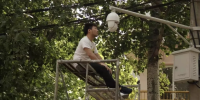
Ge Yulu’s artistic practice playfully pulls at the strings of a social system that, although seemingly all-encompassing, is in fact a malleable structure consisting of individual human beings. For his 2016 project Eye Contact, Ge positioned himself in front of a surveillance camera and stared directly into the lens for hours, then negotiated with a security guard to buy the footage.
For FX Harsono, art is activism. Over the past four decades, performance, sculpture, and painting have become his means of nonviolent protest against government autocracy and ethnic strife in Indonesia.
On February 19, 2012, the Chinese young feminism leaders, included Maizi Li and Churan Zheng, initiated an activity, "Occupy the Men Bathroom." The protesters occupied the male public restroom and invited the women waiting for the women restroom to use the male one.
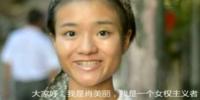
A hundred days. That’s how long it took Xiao Meili to walk from Beijing, in the arid north, to the humid, central city of Changsha. Since September, the 24-year-old has been trekking south and west across the Chinese heartland, along rumbling highways, around construction sites, down dusty streets. She stops along the way to send letters to local officials. Her plea: China must change the way it handles sex abuse.
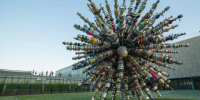
For one artist, the ugly and the beautiful are equivalent concepts. In 2018, designer and artist Choi Jeong Hwa featured an exhibition titled 'Alchemy' at The Artling where he uses recycled and non-biodegradable materials in his work that he has been collecting for 30 years, such as household trash, glass, and steel. 'Dandelion' is one of his masterpieces installed in the outdoors in Seoul, South Korea.
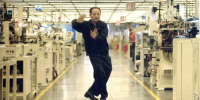
Whose Utopia? was made by the Chinese artist Cao Fei and filmed at the OSRAM lighting factory in Foshan in the Pearl River Delta in southern China during 2005 and 2006. It was commissioned as part of a project entitled ‘What Are They Doing Here?’ that was run by the Siemens Art Program from 2000 to 2006 and involved Chinese artists undertaking six-month-long residencies at industrial facilities across the country.
It can be important to reflect on the artistic recounts of activists experiences under state imprisonment. In a revealing interview with Artspace, Chinese artist and dissident Ai Weiwei reflects on his 81-day secret detention in 2011 and the psychological strategies used to dismantle identity and autonomy.
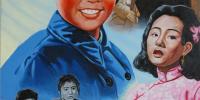
"Stand Up, Sisters" tells the story of a rural girl who journeys to Beijing for a family visit, only to be deceived and forced into prostitution, suffering unthinkable hardships. After the founding of the People's Republic of China, these women are rehabilitated. The narrative reaches its peak with her and her younger sisters' victorious achievement of self-reliance.
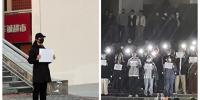
Direct Cause: The event that on November 24, several people died in a fire in a residential building in Urumqi, Xinjiang province, due to delayed disaster relief due to the COVID-19 lockdown policy in China, and the indifference of the government towards the incident and the block of message.
Primary Cause: The three-year-long lockdown policy and the government’s excessive control over speech and thought led to social discontent.
In the series The History of Korean Women, Cho's suggests that the cost of that gain cannot be paid for by a cultural amnesia masking the pain and suffering of previous generations. Here the semantic emphasis is on the official - the status of women and their contribution to the survival and growth of Korea. Their efforts have gone uncelebrated due to their relegated status within a five hundred year old social system.
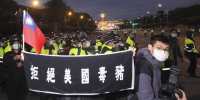
President of Taiwan, leader of the Democratic Progressive Party(DDP), Tsai Ing-wen, at a press conference with no early forecast on August 28, 2020, announcing that from January 1, 2021, American pigs containing ractopamine (Ractopamine) will be opened for those over 30 months old U.S. cattle are imported. Furthermore, the administrative order has only a 7-day notice period.
In 2009, the dissident artist created a work to honour the thousands of children who died in the Sichuan earthquake. He recalls how the project, Remembering, angered China’s rulers – and changed his career for ever
This is an edited extract from The Start podcast
It may have been a while since you’ve set foot in an internet cafe, but a pop-up one on the Lower East Side offering free tea on top of free wifi is well worth a visit for a lesson in online freedoms.
Shortly after the close of this year’s International Women’s Day, China’s Twitter-like service Sina Weibo shut down Feminist Voices. With 180,000 followers, the group’s social media account was one of the most important advocacy channels for spreading information about women’s issues in China, but in an instant, it was gone. A few hours later, the private messaging app WeChat also shuttered an account for the group.
The face of Hong Kong’s chief executive Carrie Lam is falling apart: an eyeball has fallen out of its socket and the flesh of her left chin has been ripped off. Black-clad protesters in yellow hard hats are standing on top of her head, hanging a banner with ‘Hong Kong add oil’ on her forehead and shouting into her ear with a megaphone.
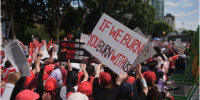
n Saturday, thousands of women in red, black, and white gathered together in Seoul for what many consider the largest women-led protest ever in South Korean history.
A photography project on China's marriage market has recently reignited the debate about marriage in China, and the phenomenon of women deemed too old to marry, or "leftover women" in the country.
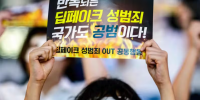
A few dozen women, wearing white masks, held up signs protesting against pornographic deepfakes. On the afternoon of Friday, August 30, several South Korean feminist collectives demonstrated in Seoul to fight these sex crimes that are flooding the country.