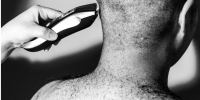
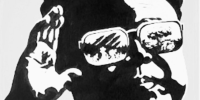
In this black-and-white image, there are no strands of hair or remnants of makeup to be found, except a shaved head belonging to a South Korean. Jeon photographed this image in 2019 for her exhibition that aimed to "destroy the socially defined idea of a woman” (Kuhn 1). The visuals in this image is a brazen response to the conventional beauty standards that has been gripping South Korean women.
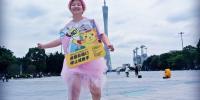
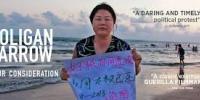
Leilei Zhang was harassed on a public bus when a man gripped her hand, glared at her and refused to let go. With the determination to raise public awareness, Leilei began a crowd-funding campaign to raise money for what could have been China's first public anti-sexual harassment advertisement. She approached the authorities of her home city, Guangzhou, but it did not want to take on the advertising for fear it would panic the public.
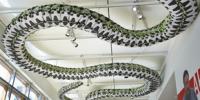
On May 12, 2008, a massive earthquake in China’s Sichuan province killed approximately 90,000 people. Ai Weiwei created this serpentine sculpture, made of backpacks, to commemorate the more than 5,000 school children who were killed when their shoddily constructed schools collapsed.
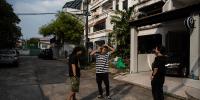
BANGKOK — The rhymes came to Nutthapong Srimuong before dawn, when Bangkok is as still as it can be and the night jasmine overpowers the Thai capital with its perfume.
The country whose capital is turned into a killing field
Whose charter is written and erased by the army’s boots
The country that points a gun at your throat
Where you must choose to eat the truth or bullets
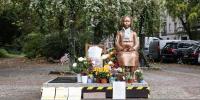
Photo taken on Oct. 15, 2020 shows a "comfort women" statue in Berlin, capital of Germany. The statue was built to commemorate the more than 200,000 girls and women from 14 countries and regions, so-called "comfort women," who were sexually enslaved by the Japanese military during World War II. (Xinhua/Shan Yuqi)
The documentary film "The Two Lives of Li Ermao" recorded the bumpy life experience of a transgender Li Ermao and her unique and moving story.
"Others only live one life, I live two." Looking back, the "two lives" are not only the emotional disillusionment and the swing of identity that Li Ermao has experienced in the past 17 years, but also her helpless but accurate summary of her life.
Nanfu Wang feels safe in New York. Surveillance, that essential preoccupation of the documentarian in America, is a chokehold from which she has been temporarily released. From her Brooklyn apartment, the Chinese filmmaker prepares for the release of her debut feature documentary, Hooligan Sparrow.
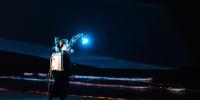
China's only seaside theater festival has been held in the resort town of Aranya in north China's Hebei Province. Artists from around the world traveled there to take deep dive into the world of dramatic performance. For theatergoers, there were interactive activities including cross-border installations such as seaside talks, environmental drama readings, screenings, theater houses, parades and bonfires by the sea.
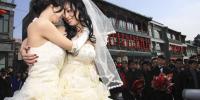
New Beijing, New Marriage is a documentary shot by Fan Popo, a Chinese gay rights activist in 2009. The film recorded that a gay couple and a lesbian couple, who were volunteers instead of real homosexual couples, were having their wedding photos taken at Qianmen Street on Valentine’s Day. Qianmen Street is a crowded and famous shopping street in Beijing.
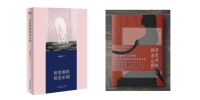
Fang Si-Qi’s First Love Paradise, a 2017 novel by Taiwanese writer Lin Yi-han, has become one of the most haunting and politically charged literary works in the Chinese-speaking world. Although presented as fiction, the novel closely mirrors Lin’s own lived experience of being groomed and sexually abused by a private tutor during her adolescence.
"Sun Mu is not the artist’s actual name. It’s a nom de plume that uses a combination of two Korean words that translate to ‘The Absence of Borders’. It not only represents what he feels is the transcendence of art but also the literal military demarcation line that keeps the Korean people separated.
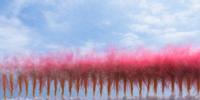
On June 26, contemporary artist Cai Guo-Qiang released the daytime firework display ‘When the Sky Blooms with Sakura’ at Yotsukura Beach in Iwaki City, as commissioned by Saint Laurent’s creative director Anthony Vaccarello.
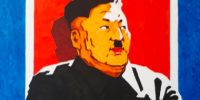
Song Byeok is one of the most acclaimed Korean artists living today. He is from North Korea, where he was a propaganda artist for the North Korean government for two decades. After defecting in 2002, Byeok has turned his prolific creativity into powerful, satirical art using North Korea’s ruling culture as motifs.
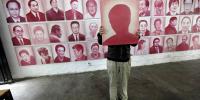
Chinese Artist Zhang Bingjian has embarked on an artistic project to promote transparency in China and Chinese government. His motivation? Discovering the extent of the corruption going on in his country. Zhang told the Toronto Star: “The chief prosecutor announced that 3,000 officials had been convicted for corruption in a single year. I remember being shocked, a little angry and then confused.”
Many girls in China may have seen the advertisements of egg donation as a surrogate, in hospitals, schools, public toilets, shared bikes, ATMs...... They are everywhere and the number of this kind of advertisements is large. Though there are lots of girls who have never seen such advertisements or would never believe in them, there would still be some girls who would dial the numbers on the advertisements.
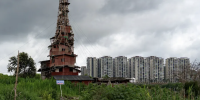
The structure teeters over fields of knee-high grass, looking like a cross between a camping tent and a giant wedding cake. Eleven stories of dark red wooden rooms, diminishing in size as they ascend, balance atop one another, seemingly held together by only the thicket of cords that stretches from the peak to the ground.
World Microphone (世界麦克风) is an organization created by students (most of them are Chinese) located in London. The organization has an account in RED, which is a popular social media in China. It often holds interviews and movements on the street in London, talking about world culture, food, and travel. Then, it makes short videos based on these interviews and movements and posts the videos on RED.
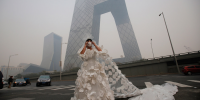
In December 2015, she stepped out in a wedding dress adorned with hundreds of air pollution masks and walked the streets appealing to Beijingers to take public transport rather than contribute to the choking smog by driving. The year before, she was photographed outside the Beijing Exhibition center in another, wedding dress complete with a 10-metre-long train in a piece entitled “Marry the Sky”.
Founded 19 years ago, the Beijing Queer Film Festival (aka Love Queer Cinema Week) is one of the grassroots film festivals in China focusing on independent queer film screenings and cultural exchange activities. We aim to expand public discussions on sexuality / gender identity / gender expression, we aim to give a platform to sexual and other minorities in China and the World, and we celebrate diversity.
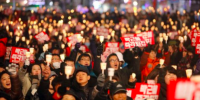
The dramatic demonstration of people power on the streets, called the “Candlelight Revolution,” was sparked off by President Park’s abuse of power and corruption. She had shared classified information on state affairs with her close confidantes, including Ms.
The following description is taken from the website of Aljazeera America (find link below):
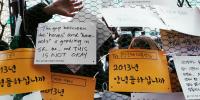
In early December, Ju Hyun-u, a student at South Korea’s elite Korea University, taped up two white sheets filled with his handwriting on a campus bulletin board. His message began with a question, “Are you doing all right?”.
Yu Hong’s Female Writer, a painted and photographic portrait of the writer Zhao Bo 趙波 (b. 1971), recalls courtly images of idealized beauties. Yu, however, deliberately complicates the perspective in her composition: she asked the sitters for her She series to select photographs of themselves that could be paired with her paintings, meaning that the images together convey dual female perspectives, both the artist’s and the subject’s.