“Some people call you the elite,” George W. Bush joked to his wealthy funders, “I call you my base.” Whether candidate Bush meant it as a joke or not, the Billionaires for Bush (B4B) campaign used humor, street theater and creative media actions to show the country how true the quip was.
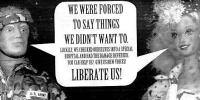
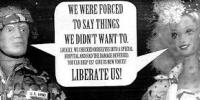
On Christmas day in 1993, kids were finding more than they bargained for under their trees: Mattel’s new talking Barbie dolls growled “Dead men tell no lies,” while Hasbro’s macho GI Joe’s chirped “I love to shop with you.”
In Drones We Trust, 2014 - Joseph DeLappe
Crowd Sourced, Participatory Rubber Stamp Currency Intervention
FOR FULL PROJECT DOCUMENTATION VISIT: http://indroneswetrust.tumblr.com/
New York Times, DAVID FIRESTONE, Published: December 31, 1993
Your son tears the wrapping paper off his fierce new "Talking Duke" G. I. Joe doll and eagerly presses the talk button. Out comes a painfully chirpy voice that sounds astonishingly like Barbie's saying, "Let's go shopping!"
Does your son:
A) Furiously vaporize the doll with his own phaser rifle?
B) Go shopping with Joe?
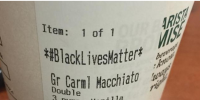
In the wake of the deaths of Alton Sterling and Philando Castile, Black Lives Matter supporters are finding creative ways to make sure the movement is acknowledged everywhere.
When ordering at Starbucks, people have changed their name to “Black Lives Matter” so that, when their order is up, the baristas have to yell out their new moniker.
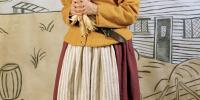
This installation of 13 photographic self-portraits explores European-American heritage, my family and their role in the history of racism, colonization, genocide, and classism. The ancestors, real and imagined, span over 2000 years from the Celtic Iron Age to the present day. The life size portraits are accompanied by audio diaries from the perspective of each character.
Late last year, the New York Times published an op-ed short film written and narrated by Jay Z. The clip was called “The War on Drugs Is an Epic Fail,” and that kind of title was explicit enough for everyone to grasp the entertainment mogul’s general argument, whether they knew anything about drug war or not.
Independent producer and longtime WWNO collaborator Eve Abrams brings us Unprisoned: Stories From The System. From New Orleans and Louisiana, the world’s incarceration capital, we meet those serving time inside and outside the criminal justice system.
Mass media using propaganda to brainwash citizens. Confusion and ignorance causing a divide. People rising up against an oppressive government. Humans being torn between rage and love. These are the themes of Green Day’s widely successful 2004 album, “American Idiot.” These themes still sound familiar. Nearly two decades later, the world, especially the United States, faces these same issues.
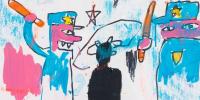
“It could have been me,” Jean-Michel Basquiat would say at the mere mention of the untimely death of Michael Stewart. Stewart, a 25-year-old artist, was allegedly drawing on the walls of the subway on 15 September 1983 when he was approached by transit cops who then placed him under arrest.
Trickery and disguise, usually followed by revealing the truth, are often tactics used by liberal activism, like the Yes Men for example. When used by the right, however, it can have different implications. Pretending to be a CEO or billionaire in order to expose corporate greed and corruption is clearly different then pretending to be a minority. The use of disguise can manipulate and shed light on hierarchies of power.
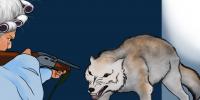
The National Rifle Association has recently decided that the way to promote their gun rights among the American people is to retell the classic stories with guns. Thus far, they have rewritten The Little Red Riding Hood and Hansel and Gretel, handing guns into the hands of the children protagonists, resulting in, surprisingly, significantly less bloodshed.
Jordan Peele discovered halfway through the making of “Get Out” what story he wanted to tell: A horror-thriller for black audiences that delivered a searing satirical critique of systemic racism.
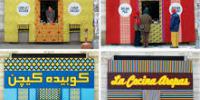
Conflict Kitchen is a restaurant that only serves cuisine from countries with which the United States is in conflict. Each Conflict Kitchen iteration is augmented by events, performances, publications, and discussions that seek to expand the engagement the public has with the culture, politics, and issues at stake within the focus region. The restaurant rotates identities in relation to current geopolitical events.
In May 2020, a team of artists, activists, folklorists, and people who lost loved ones to Covid-19 came together to make monthly memorial sites in New York City to remember victims of the Covid-19 pandemic. They continued installing memorials around New York City every month during the summer of 2020.
Vermin Supreme is an American performance artist, anarchist and activist who is known for running as an alternative candidate in various local, state, and national elections in the United States since 1988. Supreme is known for wearing a boot shaped hat and carrying a large toothbrush. Vermin Supreme's four-plank platform is simple, yet elegant:
1) Mandatory tooth-brushing laws.
2) Zombie preparedness.
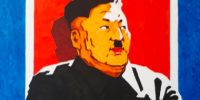
Song Byeok is one of the most acclaimed Korean artists living today. He is from North Korea, where he was a propaganda artist for the North Korean government for two decades. After defecting in 2002, Byeok has turned his prolific creativity into powerful, satirical art using North Korea’s ruling culture as motifs.
The Partnership for Drug-Free Kids, a national nonprofit dedicated to reducing substance abuse among adolescents, launched a new multimedia campaign for teens that uses emojis to communicate the challenges of negative influences, empowering them to live Above the Influence.
A CALL TO ARTISTS:
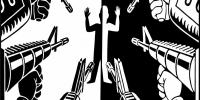
The American Friends Service Committee (AFSC) has created a new, nationally touring poster exhibit called All of Us or None: Responses and Resistance to Militarism. The exhibit will launch in June and is already scheduled to travel to Chicago, Greensboro, Providence, and San Francisco with many other stops anticipated. We are looking for some additional work to include in this show.