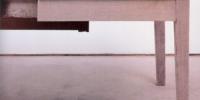
Doris Salcedo talked extensively with victims of the violence in Colombia. For the project titled Unland she spoke specifically with children who had witnessed the murder of their parents. This piece was a poetic response and representation of their testimony. Salcedo combined halves of tables together to make a whole. In the seam where the tables joined Salcedo meticulously sewed the tables together using white silk thread, dark hair and bone.
It has been a long and exhausting battle for the bike activists in Puebla one of the cities in Mexico. Collectives and activist groups have long pushed for including bike infrastructure around the city, in a horizontal, democratic way.
Covenant House has started a ‘Sleep Out’ movement that shines light on the youth homelessness crisis and raises funds for young people who seek shelter. "Covenant House empowers young people to overcome homelessness and trafficking by providing them with safe housing, food and clothing, and relentless support. Sleep Out events are held for people who want to join the movement as they give up their bed for one night in NYC.
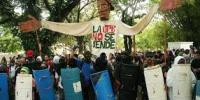
Ahead of Monday’s planned protest, police set up a barricade around the presidential palace, which a spokesperson described as a “peace wall” to prevent vandalism, the Guardian reported. But protesters said the barrier was symbolic of the president’s refusal to take on the issue, noting that he frequently makes a show of traveling in drug cartel-controlled parts of Mexico but felt unsafe ahead of their protest.
Fashion designer and social scientist, Lucia Cuba, has taken up the task of using fashion as a vehicle to bring attention and awareness around Articulo 6, an article in the Peruvian constitution that declared a law of forced sterilization of women in the country. Cuba has taken the testimonies of the victims of this article and integrated them into the very fabric of her designs.
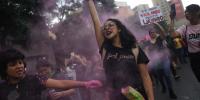
On August 16, 2019 thousands of women marched in various cities across Mexico. One particular case may have triggered them, but these marches were an answer to the systematic violence against women and girls in our country.
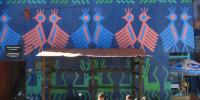
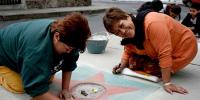
Nestled on the banks of Lake Atitlán in Guatemala, Santa Catarina Palopó is a small town brimming with vibrant colors and stunning natural views. Despite its natural beauty and cultural heritage, the community struggled with economic development and poverty for years until they had the opportunity to harness the power of art and transform the town.
Tranvía Cero is a group of artists from Ecuador who have been creating artistic projects with the aim to empact community lives and change the ideas of art as an exclusive terrain. The describe their goal as a redefinition of art through the social engaging experiences.
A technological feat has emerged amid the Chilean protests. A video of protestors bringing down a police drone has gone viral on social media sites. These protestors didn't use any physical or gun force to bring the drone down. Instead, they used another form of technology: lasers. A lot of bright green laser beams were pointed in unison at the drone, which can be seen moving erratically, before quickly falling down to Earth.
SAO PAULO, May 16 (Reuters) - At one of Latin America's largest commuter bus terminals in Brazil's gritty downtown Sao Paulo, 84-year-old Rerizenil de Paula Santos waits on a bus decorated with neon lights and bright graffiti amid the hustle and bustle of rush hour.
Aníbal López, also known by his government identification number A-153167, is a pioneer of performance art in Central America. ArtBus describes his work as, "Generally aimed at immersing viewers into the region’s social and political tensions, his works combine the dry language of 1960/1970s conceptual art with the revolutionary ethos of a Latin American guerrillero.
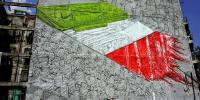
Italian street artist Blu was recently in Mexico to participate at the ManifestoMX Street Art Festival where he completed this intense and politically charged mural in opposition to the Mexican authorities.
The work of a radical theater and puppetry collective, known as Papel Machete, produces and performs throughout Puerto Rico and the United States. Papel Machete was established on May 1, 2006 during protests responding to the government shutdown and political and economic crisis prompted by Puerto Rico’s status as a United States colony.
"Brazilian artist Mundano is used to spending his time on the road and in the streets, making art as an act of protest. Known for leaving his colorful works of graffiti on walls around the world, Mundano is especially dedicated to issues of environmental and social justice and spotlighting the overlooked work of Brazil’s trash collectors through his Pimp My Carroça campaign.
Thousands of Indigenous activists and environmentalists have converged in one of the Amazon’s biggest cities to voice their hopes and fears about the future of the world’s biggest rainforest.
The Brazilian city of Belém will this week host a two-day conclave bringing together the presidents of eight Amazon nations including Brazil, Colombia, Peru and Venezuela.
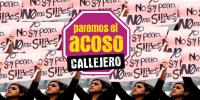
This is an organization and online platform that registers cases of street harassment in Peru and disseminates information about the subject. People can report cases and get in touch with the organization to talk or learn more about what to do when being sexually harassed.
In response to an earlier project called "Daily Bread, Gregg Segal collaborated with the United Nations Refugee Agency to bring awareness to the crisis of refugees fleeing Venezuela through his project "Un-Daily Bread."
The odd spaces exiting under bridges and viaducts around the world are often left aside, urban spatial residues mostly abandoned or occupied informally by homeless people drug users etc. The former pro boxer Nilson Garrido saw the space under the Alcantara Machado viaduct (in the Mooca neighborhood of Sao Paulo) as an opportunity to create a Boxing Academy.
Estados de excepción (States of Exception) is series of participatory cultural interventions created for women to freely and joyfully exercise our rights in public and secure environments, currently being produced in Mexico and abroad.
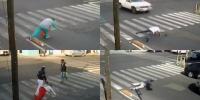
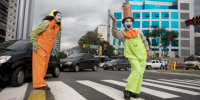
"Mimes gesture as they stand in a crosswalk in Caracas, Venezuela, Friday Oct. 7, 2011. The mayor of the city's eastern district of Sucre has launched a unique program aimed to encourage civility among reckless drivers and careless pedestrians, putting 120 mimes at intersections to politely and silently scold violators"
Elina Chauvet’s red shoes are worldly. They’ve been in Milan, Italy, and Grand Rapids, Michigan. Not just one pair, but hundreds — red boots, red heels, red toddler shoes. They’re not there to see the sights, but to take up space. Especially when the women or girls who would have worn them no longer take up any space, except in the lives of their loved ones.
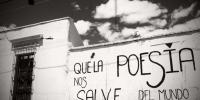
The Acción Poética movement is a literary phenomenon that began in Monterrey, Mexico in 1996. It was founded by Mexican poet Armando Alanis Pulido and involves painting and intervening abandoned walls in cities with fragments of poetry. The content is usually love poems or optimistic phrases. Also, some phrases refer to the current situation in the cities (though one of their rules is to not talk about politics or religious beliefs).