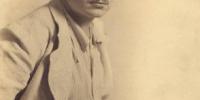
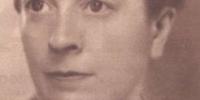
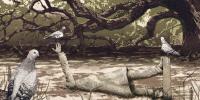
Josep Renau Berenguer was a Spanish painter, photomontager, muralist and communist militant.
Renau was the son of an Art teacher. Due to his father’s low income, he had to work various jobs during his youth and teenage years to maintain a middle class position.
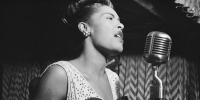
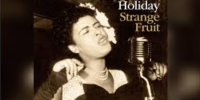
In March 1939, a 23-year-old Billie Holiday walked up to the mic at West 4th's Cafe Society in New York City to sing her final song of the night. Per her request, the waiters stopped serving and the room went completely black, save for a spotlight on her face.
Rufina Bazlova is not afraid to surrender her art to activism. Born in Belarus, a former Soviet republic ruled by the authoritarian leader Aleksandr Lukashenko for 29 years now, Bazlova knows all too well that being apolitical is a privilege many Eastern Europeans cannot afford. 2020 was a pivotal year for Belarus, not only because of the COVID-19 pandemic but also the presidential elections, which declared Lukashenko president for the sixth time.
Join other families in reimagining sports team mascots and logos that misrepresent Native American communities. Design a campaign for alternative names with the help of artists Sam Durant and Elisa Harkins, taking inspiration from the exhibition Jimmie Durham: At the Center of the World.
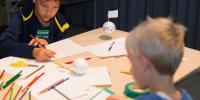
Pop-Up Studio
Families explore art and create together in lively workshops led by artists. These drop-in programs are designed for ages 5 and up.
Encarnación Aragoneses Urquijo (886-1952), commonly known by her literary pseudonym Elena Fortún, was a Spanish writer who focused in children and teenagers literature.
She was born in Madrid, where she studied Philosophy and Humanities. In 1908 she married Eusebio de Gorbea y Lemmi, a member of the republican army. They left the country after the Civil War to live frist in France and then in Argentina.
Join acclaimed director Velcrow Ripper (Scared Sacred, Fierce Light) on a journey deep inside the revolution of the heart that is erupting around the planet, as he asks the question, “How could the crisis we are facing become a love story?”
Many may not realize, but legendary jazz singer Billie Holiday was a big part of the Civil Rights Movement. In fact, her 1939 song about lynching, “Strange Fruit,” made her a target of the FBI.
One of the most significant aspects of the wave of protests and uprisings that began in Syria in 2011 was the use of the cell phone camera as a tool of documentation, political activism, and creative expression.
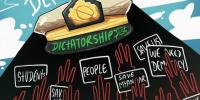
On Wednesday, December 15th 1976, a referendum was held in Spain. The question was to pass or not to pass the Ley para la Reforma Política (Political Reform Act). This Act was the legal instrument that allowed Spain to transition between Francisco Franco’s dictatorship to a democratic constitutional regime, a parliamentary monarchy.
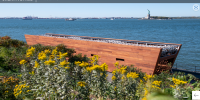
Moving Chains is a monumental 110-foot long kinetic sculpture that evokes the hull of a ship, built from steel and Sapele, a tree native to West Africa commonly referred to as African Mahogany. Inside of the sculpture, nine chains run overhead: rotating on a maritime sprocket system, eight of the chains represent the pace of the currents in New York Harbor, while a ninth central chain moves more quickly, mimicking the pace of a ship in transit.
This special EDition is a revolutionary chant against the menacing cantankerous demonic , satanic COVID 19. And again doubles as a bold and poetic supplication to the great Almighty God to release us off this pandemic bondage. This Edition is a poetically driven spiritual prayer for freedom of expression and freedom after expression.
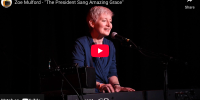
"The President Sang Amazing Grace" tells the story of the 2015 attack that claimed nine lives at the Emmanuel AME Church in Charleston, SC. It first appeared on Zoe's 2017 album "Small Brown Birds" and was widely played on independent folk radio shows across the US. Since then, the song has taken on a larger life, inspiring a variety of artists and finding its way to new audiences.
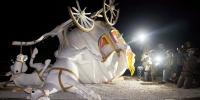
“He describes it as a “family theme park unsuitable for small children” – and with the Grim Reaper whooping it up on the dodgems and Cinderella horribly mangled in a pumpkin carriage crash, it is easy to see why.
Banksy’s new show, Dismaland, which opened on Thursday on the Weston-super-Mare seafront, is sometimes hilarious, sometimes eye-opening and occasionally breathtakingly shocking.
from ahramonlineby Sara ElkamelAn indelible link has materialised between artistic expression and
revolution. Maybe it is the features they share: freedom, deviance and
fluidity, which bring them so close together.
In any case, Egypt’s January 25 Revolution undeniably led to a
surge of creativity across the country; a rebel’s passion merges with an
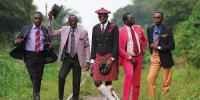
Their name, Sapeurs, comes from the French slang se saper, meaning to dress with class, but also from the acronym of their social group : La Société des Ambianceurs et des Personnes Élégantes (the Society of Ambianceurs and Elegant Persons). La Sape can be traced back to the early years of colonialism.
A new exhibition titled “Afrofuturism: A History of Black Futures” will debut at the National Museum of African American History and Culture (NMAAHC) to examine Afrofuturist expression and culture as it relates to music, activism, art, and more.
For the past five years, we’ve screened SIMA juried films in communities and classrooms across six continents and witnessed an increasing demand to use the inspirational force of documentary filmmaking to build a global digital community around today’s most pressing issues.
An inspired story of artists who have made millions engaging their communities of using their artistic influence to create change for others!
****
Over the last few years or so, Diddy and Jay-Z have continually found themselves near the very top of Forbes' wealthiest acts in hip-hop list. Now, it looks like the two are combining their immense wealth to help Black people across the U.S.
The story of an artist. Laolu Senbanjo grew up surrounded by the culture and mythology of the Yoruba, an ethnic group from the southwest of Nigeria, but he never imagined how it would influence the artist he is today. After a career as a human rights attorney, Senbanjo moved to New York City to pursue art full time. “With my art, I like to tell stories, I like to start a conversation,” says Senbanjo, but life as an artist in New York was tough.
Mine is not Arts for the sake of Arts. It is a revolutionary INSGINA carved into the artistic plaque of my DNA to speak FREEDOM of expression and then freedom after EXPRESSION. The footprints of my revolutionary walk are dipped in the paths of RESISTANCE. My Ideological Swag -word is CREATIVITY. My spiritual birth mark is RESILIENCE. My revolutionary slogan is a nonviolent but a poetic fist of MASS INSTRUCTION. I am non-selfish believer.
One of the most pressing questions before us in the United States now is how to resolve the tension between our personal visions and needs, on the one hand, and the demands of being a member of a community, on the other.
"An atmosphere of fear and anger spread across Myanmar this week as millions of people awoke to find out the military had taken control, ousting the elected government.
But how do you fight back in a country where protests have been violently suppressed before?
For some, it has meant putting pen to paper and taking the battle online.