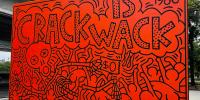
Without having been commissioned—or even given legal permission at all—Haring set out to create Crack Is Wack on the wall of an abandoned handball court in a park at 2nd Avenue and East 128th Street on June 27, 1986. Upon the completion of the mural, Haring was arrested by the New York City Police Department for vandalism of city property and faced potential jail time in addition to heavy fines.
A coalition of more than twenty national arts funders has launched an emergency relief fund that will provide millions of dollars to artists struggling financially in the wake of the COVID-19 outbreak in the United States, which has more than 400,000 confirmed cases of the virus. The Andrew W.
Yesterday, I procrastinated my way to watching the Savage X Fenty Show, and I was left in complete awe of Rihanna. She truly is a powerhouse, but on top of that, all her brands; Fenty Beauty, Savage X Fenty and Fenty have intentionally left no one behind.
Early Sunday morning, the Dallas Police Department's Twitter account tweeted for followers to download its iWatch Dallas app and share videos "of illegal activity from the protests." The police are looking to arrest lawbreakers at weekend demonstrations decrying police violence against black people. The benefit of the app, according to the tweet, was the ability for informants to stay anonymous.
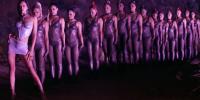
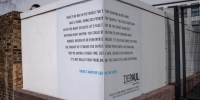
"This Ain't a Eulogy" is both a staged performance and a durational, outdoor, public performance that reclaims and takes public space. The artist statement is as follows:
In March 2016, Chinese feminist activists had planned to launch a crowdfunding campaign against sexual harassment advertisements, and they worked hard to raise 40,000 yuan in a month and a half. However, after perfunctory, evasive, and rejection by the relevant departments, anti-sexual harassment advertisements finally failed to go online.
In November 2015, Chinese LGBT activist Chen Qiuyan met with government officials in Beijing after months of campaigning to have the Ministry of Education remove textbooks which identify homosexuality as a mental disorder.
In 2001, the Chinese Society of Psychiatry removed homosexuality from its list of recognized mental disorders, after the Chinese government decriminalized consensual homosexual acts in 1997.
It’s not easy to stop the construction of natural gas pipelines, but several years ago the ecological artist and activist Aviva Rahmani came up with an ingenious idea: what if you could protect threatened landscapes by turning them into art?
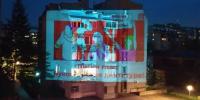
For the past few years around election time in Serbia, people have taken to the streets to protest government corruption, attacks on free press and voter suppression. This Spring, despite a nationwide lock-down to combat the COVID-19 pandemic, activists are finding new ways to protest the country’s increasingly-repressive government.
Ahead of a recent exhibition at the prestigious modern art museum OCAT Shanghai, the artist Song Ta described the process of creating his multimedia piece “Uglier and Uglier.” After secretly filming thousands of unsuspecting female college students, Song and three assistants painstakingly ranked them by their perceived attractiveness; those deemed most appealing featured early in the show, with the women on display getting progressively “uglier” as the
The Resistance Arts Trust Political Action Committee is a Super PAC with the mission of challenging great Artists to create public works of political art meant to inform communities, start conversations and drive media coverage on progressive issues, and empowering artists and the arts to a greater role in American political discourse.
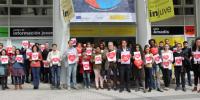
The No Hate Speech campaign has come to its fourth anniversary this week, because it was on the 18th of March 2013 when the Spanish Institute for Youth IMG_9707(INJUVE) officially launched the campaign in Spain, to commemorate the 21st of March, declared by the UN as Day for the Elimination of Racial Discrimination of that year.
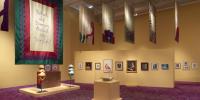
“Judy Chicago: Herstory” will span Judy Chicago’s sixty-year career to encompass the full breadth of the artist’s contributions across painting, sculpture, installation, drawing, textiles, photography, stained glass, needlework, and printmaking. Expanding the boundaries of a traditional museum survey, the exhibition will place six decades of Chicago’s work in dialogue with work by other women across centuries in a unique Fourth Floor installation.
"SOA Cycle, and what it later became, which is called the Democracy Cycle, is a group of seven large works that approach the question of democracy. What is democracy? How is it constructed? How is it implemented? Is it something that is to be thought of in relation to its political influence? Or is it something that plays out in terms of cultural and social, and even emotional terms, for instance?
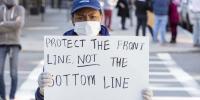
Working in a grocery store has earned me and my co-workers a temporary status. After years of being overlooked, we suddenly feel a sense of responsibility, solidarity, and pride. On a private Facebook group page for my company, Trader Joe’s, one employee from Washington State posted a picture of a company-issued work shirt hanging from the ceiling of the store. A sign attached to the shirt read not all heroes wear scrubs.
From the two shores of the Mediterranean, Zoukak theatre company and cultural association (Beirut) and Center for cultural decontamination CZKD (Belgrade) collaborates by sharing their experiences and knowledge in working within sociopolitical contexts in the field of art and culture.
Festival “WakEUp!” (organized by “Heartefact”) happened at several locations, and included film and exhibition program. Festival originated from the need for a reaction to the present moment refugee crisis and the situation in the world, began on the 7 th of December at Gallery “G12 Hub” in Belgrade with two days performance that was dedicated to the current problem of refugees and their historical destinies.
In state capitals and street protests, women’s rights activists have been wearing red robes and white bonnets based on “The Handmaid's Tale,” the 1985 novel that is now a series on Hulu.
Silent, heads bowed, the activists in crimson robes and white bonnets have been appearing at demonstrations against gender discrimination and the infringement of reproductive and civil rights.
"Street corners are used to maximum effect by British youth homelessness charity Depaul UK in a new campaign created by Publicis London.
The idea is to show another side to homelessness to raise awareness of Depaul’s Nightstop–a service which provides emergency accommodation to homeless 16-to-25-year-olds–to recruit new volunteers.
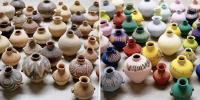
Exhibition visitors have expressed feelings of uneasiness or even pain and nostalgia when seeing Colored Vases by Ai Weiwei1. The 51 vases that make up the artwork are originally treasures from the Neolithic Age (5000–3000 BCE) and the artist has dunked them in common industrial paint.
Why did Ai Weiwei do it?
Ah, the unsolicited dick pic. Technology has made it all too tempting for men's penises to pop up on a woman's phone while she's reading on the train or walking home from work. This is a fairly recent invention, because who would've taken their rolls of film to the local drug store to get their dick pics developed?