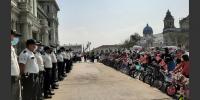
Hundreds of taxi drivers gathered together on the streets of Mexico City protesting against Virtual apps like Uber and Cabify. They formed a caravan and stopped the traffic for hours, as a way of denouncing unfair price competition.
In 2017, the political party Ahora Buenos Aires (Now Buenos Aires) was running in the legislative election for the first time. It is not easy being a small left-wing party in the City of Buenos Aires, therefore imagination is an essential part of a campaign if you want to get the attention of the media and voters.
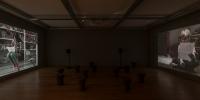
The protagonism of the body in the dramatization of marginalized groups is also central to Emilio García Wehbi's Proyecto Filoctetes, an urban intervention staged November 15, 2002, on the streets of Buenos Aires. The project consisted in placing twenty-five lifelike latex mannequins in central, highly trafficked locations around the city in varying positions of injury, physical distress, and abandonment.
For over 60 years, Colombia has been facing war between guerrilla groups, the State, paramilitary groups and drug dealers. Hundreds of thousands of people have been killed, raped, displaced and threaten by this armed conflict. The common trait of this tragedy has been the people being in the middle, the people that still today pay the consequences.
During the 2020 and 2021 social protests in Chile, Colombia, and Peru, Latin American fans of K-pop, Korean popular music and culture that mixes rhythms, styles, dance routines and has a defined aesthetic, went from using social networks to support their favorite artists to using them to sabotage the hashtags of conservative influencers that discredited the mobilizations.
Beating Cancer is a hard task. Cancer patients spend endless days in the hospital receiving a multitude of tolling treatments that we understand are necessary to save our lives. However, when you're a kid, it isn't always so easy to understand what's going on. As the chemo kills bad cancer cells, it also kills good cells in your body, which causes various unpleasant side effects.
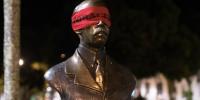
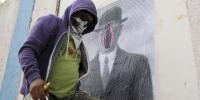
An artist in Brazil, who remains anonymous, placed red blindfolds on the eyes of statues across the city of Rio de Janeiro to protest the country's political crisis.
A technological feat has emerged amid the Chilean protests. A video of protestors bringing down a police drone has gone viral on social media sites. These protestors didn't use any physical or gun force to bring the drone down. Instead, they used another form of technology: lasers. A lot of bright green laser beams were pointed in unison at the drone, which can be seen moving erratically, before quickly falling down to Earth.
"A week-long party characterizes Brazil’s Carnival, the Mardi Gras of the southern hemisphere. Celebrations and parades are held throughout the country, most notably in the city of Rio de Janeiro and the Brazilian states of Bahia and Pernambuco. Carnival celebrations vary in length and content, depending on the area.
Entre el 2004 y el 2014 se registraron 982 víctimas de ataque con ácido en Colombia. En el 41 por ciento de los casos, el agresor no fue identificado. El aumento de casos llevó a que en enero pasado se promulgara una ley que endurece los castigos contra ese flagelo y con la que se busca reducir al máximo esta situación en todo el país.
Non-profit organizations and a multitude of Guatemalan girls protested together demanding justice and security from the government. Guatemala's insecurity and cases of girls' disappearances have increased over the years. The protest started outside the Government Ministery (Ministerio de Gobernación) early in the morning, where protestors gathered riding their bikes.
Daniel Arzola, a digital artist and activist originally from Maracay, Venezuela, began his series, 'No Soy Tu Chiste' ('I Am Not A Joke') in 2013 intent on combating the stereotypes and cruelty so often facing LGBT identifiers; youth in particular. The project went viral in 2014, around the same time it teamed up with the It Gets Better Project based in the United States.
More than 20 years ago, a psychology student doing his training at one of Argentina's oldest psychiatric wards kept being asked by his family and friends what it was like to work in there. So he came up with an idea: to let the patients explain in their own words.
The first radio station to broadcast from inside a mental hospital was born.
In 1998 Hacker-Poet-Artist Yucef Mehri breached the security of CANTV at the time the largest telecommunications company in Venezuela. He was able to access the personal data kept by the company which contained the names, addresses, phone numbers, working places, and even checking accounts, credit cards, and expiration dates of it's customers.
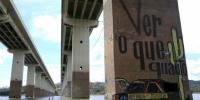
A grey minivan rattled through São Paulo’s hilly suburbs, loaded with spray cans, paint rollers, buckets and a ladder as five street artists drove to the Atibainha river, rap lyrics blaring from their speakers.
On the sweltering afternoon of 26 February, they painted colourful protest murals on the legs of a bridge that crosses one of São Paulo’s most important water sources, nestled in the Serra da Cantareira mountain range.
From Public Delivery:
"The Land Mark series was a civil disobedience campaign. Over 2001 and 2002, Allora and Calzadilla, together with a group of activists, encroached into one of the United States Navy Bombing range in a beach of Vieques, Puerto Rico. The U.S. Military and NATO have used this location for various military exercises for more than 60 years.
I think this is a very interesting project that is intended to pay hommage by showcasing portraits of survivors of the Cuban revolution. They are displayed in the streets of Havana and, as the artists explains, this is a place that lacks commercial advertising/ billboards in the streets. So they are displaying the courage and strength of those, people who should be admired, earned their place in a sense.
This is an organization and online platform that registers cases of street harassment in Peru and disseminates information about the subject. People can report cases and get in touch with the organization to talk or learn more about what to do when being sexually harassed.
Through his environmental, social justice organization, Instituto-E, Dr. Oskar Metsavaht, the creative director behind ethical fashion brand, Osklen, joined forces with Rainer Nolvak, founder of international civic sanitation movement, Let's Do it and Umer Pter, head of External Relations and Estonian delegate at the Rio+20 U.N.
While governmental support for arts and culture is often meager, the Brazilian national government has recently demonstrated great interest in the industry. They've just introduced a "cultural stipend," which provides workers with 50 real (roughly $25) per month for arts and cultural expenses. The allowance covers personal spending on things like movies, concerts, books or museums.
In March this year, less than 100 days since he took office again, Luis Castañeda Lossio, Mayor of Lima, announced that the Municipality would remove the street art murals painted on the walls of downtown Lima’s historical city streets. “Lima has to recover all the architectural quality it has. They have chosen us and we will comply with the obligation that the population has consigned us,” said the mayor.